
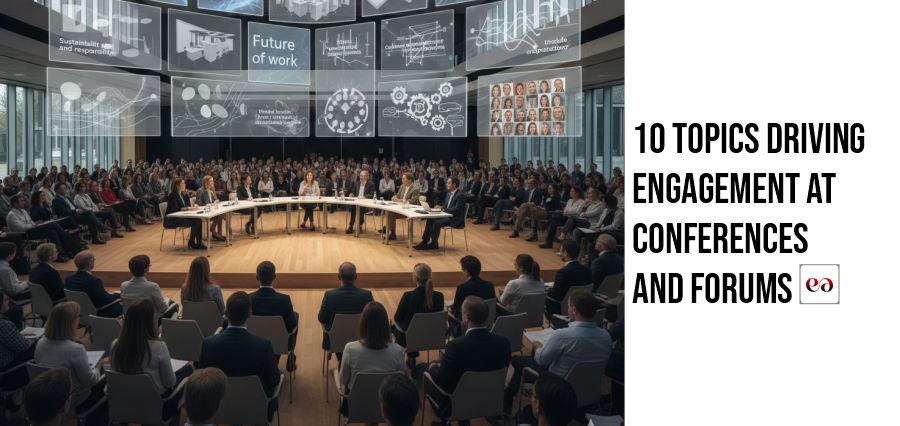
Conference audiences are sharper than ever. They arrive informed, distracted, and selective about where they invest attention. Engagement now comes from relevance, clarity, and ideas that respect people’s time. The topics below consistently spark participation, questions, and post-event conversation because they speak to real pressures and real curiosity.
AI sessions draw crowds, but only when the conversation moves beyond theory. Audiences want to see how tools perform under real constraints like budget, skills, and ethics.
High-engagement talks focus on practical use cases, lessons learned, and limits. Panels that include both builders and users perform especially well. Live demos, post-mortems, and honest discussions about failure keep people engaged because they feel grounded and useful.
People are tired of bold predictions that never land. What resonates now is specificity.
Sessions that explore how work is changing today, not someday, perform best. Topics like hybrid team dynamics, performance measurement, and leadership in distributed environments spark real discussion. Audiences engage when speakers acknowledge tension and trade-offs rather than selling a single model.
Leadership content remains evergreen, but the tone has shifted. Audiences respond to honesty over inspiration alone.
High-performing sessions focus on decision-making under stress, leading through ambiguity, and earning trust when answers are incomplete. Case-driven talks outperform abstract frameworks. People lean in when leaders share what did not go according to plan and how they adjusted.
Sustainability sessions draw engagement when they move past branding and into operations.
Audiences want to understand how sustainability decisions affect cost, supply chains, hiring, and long-term risk. Forums that include data, trade-offs, and measurable outcomes generate thoughtful questions and debate.
This topic continues to resonate because it touches lived experience. Engagement increases when sessions respect complexity and avoid oversimplification.
The strongest talks focus on systemic contributors to burnout, not just individual coping tactics. Discussions about workload design, leadership behavior, and organizational responsibility draw meaningful participation.
Trust is no longer a soft topic. It is a strategic one.
Sessions that examine data privacy, algorithmic bias, misinformation, and transparency consistently attract engaged audiences. People participate when ethical questions are framed as business and societal decisions, not abstract philosophy.
Panels that include diverse perspectives, such as legal, technical, and human impact voices, keep conversations balanced and credible.
Audiences engage when customer experience is treated as behavior, not branding.
High-performing sessions break down how companies listen, respond, and adapt to customer signals in real time. Stories about friction, recovery, and missed expectations resonate more than success-only narratives.
This topic works because it connects strategy to day-to-day execution. It also invites audience participation since nearly everyone has direct customer stories.
Innovation content draws attention when it addresses internal resistance.
People want to know how ideas move from whiteboards to execution. Sessions that explore incentives, organizational structure, and leadership support perform well. Engagement rises when speakers explain how innovation fails inside companies and what helped unblock progress.
Engagement increases when this topic is treated as an operational challenge, not a moral lecture.
Audiences respond to discussions about hiring systems, promotion pathways, and accountability. Data-backed talks that show what worked and what did not invite thoughtful dialogue rather than defensiveness.
Storytelling sessions remain popular because they apply across roles.
High-engagement talks focus on clarity, structure, and audience understanding rather than performance alone. Leaders, marketers, and technical professionals all benefit when storytelling is framed as a thinking tool.
Workshops and interactive formats perform especially well here. People enjoy practicing and receiving feedback, which drives participation and retention.
These ten themes share three traits.
They address current tension rather than distant possibility.
They respect audience intelligence.
They connect ideas to decisions people make at work.
Conferences and forums succeed when content feels useful the moment people return to their desks. Engagement follows relevance, honesty, and practical insight. When topics meet those standards, attention comes naturally and search visibility follows.
Also Read : 7 Qualities Audiences Expect from Keynote Speakers Today



Welcome to the future of digital storytelling, where creativity meets innovation. We’re not just a magazine platform; we’re a team of passionate visionaries committed to transforming how stories are shared, celebrated, and experienced in the digital age. Join us as we inspire, inform, and redefine the world of digital magazines.
© Copyright 2025 | educationeureka | All Rights Reserved.