
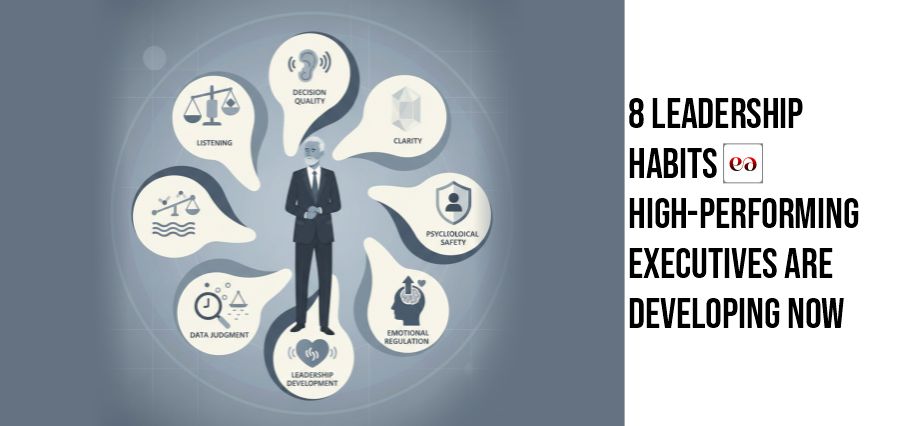
High-performing executives are not winning because they work longer hours or speak louder in meetings. They are winning because they practice a set of leadership habits that compound over time. These habits shape how decisions are made, how teams perform, and how organizations adapt under pressure.
Leadership at this level is no longer about authority. It is about clarity, trust, and execution in complex environments. Below are eight leadership habits that top executives are actively developing right now, and why each one matters.
Strong leaders do not try to decide everything. They focus on deciding the right things.
High-performing executives are ruthless about identifying which decisions truly matter. They slow down for high-impact choices and speed up or delegate the rest. This habit reduces decision fatigue and improves consistency across the organization.
They also design decision frameworks in advance. Clear criteria, defined trade-offs, and explicit ownership prevent endless debate. Teams know when input is needed and when alignment is enough.
This habit signals confidence. It also builds momentum.
Listening has moved from a soft skill to a competitive advantage.
Top executives listen to understand patterns, not just opinions. They pay attention to what is repeated, what is avoided, and what is said offhand. This gives them early insight into risks, opportunities, and cultural issues.
They also listen beyond their immediate circle. Customers, frontline employees, and cross-functional partners often see problems before leadership does. High performers create channels where that information travels upward without fear.
Listening well shortens the distance between reality and leadership.
High-performing executives do not communicate more. They communicate better.
Every message has a purpose. Is it to align, to decide, to motivate, or to challenge. They are clear about which one it is, and they remove unnecessary noise.
They also repeat what matters. Strategy, priorities, and values are reinforced through consistent language across meetings, emails, and one-on-ones. This repetition creates shared understanding without micromanagement.
Clarity reduces confusion. Confusion is expensive.
The best leaders create environments where people can speak honestly and still be held accountable.
High-performing executives encourage dissent, questions, and early warnings. They reward truth over comfort. At the same time, they are explicit about expectations and outcomes.
This balance is intentional. Psychological safety without standards leads to complacency. Standards without safety lead to silence.
When both exist, teams move faster and make fewer avoidable mistakes.
Busy executives often confuse motion with progress. High performers do not.
They protect time for thinking. Not reacting. Not updating. Thinking.
This includes time for strategic reflection, scenario planning, and learning outside their immediate domain. Some block it on their calendar. Others use structured routines like weekly reviews or quarterly offsites with themselves.
Clear thinking is not a luxury. It is a leadership responsibility.
High-performing executives measure success by what scales without them.
They invest in developing judgment, not just skills, in their leaders. This means coaching people on how to think through ambiguity, how to prioritize under pressure, and how to lead others.
They also give real ownership early. Stretch roles, visible decisions, and meaningful accountability accelerate growth far more than training programs alone.
Organizations that grow leaders internally move faster and retain trust during change.
Data is everywhere. Wisdom is not.
Top executives use data to inform decisions, not to avoid them. They know which metrics indicate direction and which simply describe the past. They ask better questions of the data instead of demanding more dashboards.
They also balance quantitative signals with qualitative insight. Customer stories, employee sentiment, and market intuition still matter.
Data supports judgment. It does not replace it.
Leadership is contagious. So is stress.
High-performing executives pay close attention to how they show up. Their tone in meetings. Their reaction to bad news. Their availability under pressure.
They manage their energy through boundaries, recovery, and self-awareness. This is not about wellness trends. It is about consistency and trust. Teams perform better when leadership behavior is predictable and grounded.
Calm leaders create calm organizations, even in volatile conditions.
The environment executives operate in today is more complex than ever. Faster cycles, distributed teams, constant change, and higher expectations leave little room for outdated leadership models.
These habits help leaders cut through noise, build resilient teams, and execute with clarity. They also compound. A leader who listens well makes better decisions. Better decisions build trust. Trust enables speed.
This is how high-performing executives stay effective, even as the landscape shifts.
Developing leadership habits is not about dramatic transformation. It is about small, consistent shifts.
Start with one habit. Observe your current behavior. Choose a simple action you can repeat weekly. Protect time for reflection. Ask for feedback from people who see you lead every day.
Progress in leadership is rarely loud. It shows up in better conversations, clearer priorities, and teams that move with confidence.
That is what high-performing executives are building now.
Also /read : 5 Reasons Executive Coaching Is Becoming Essential for Senior Leaders




Welcome to the future of digital storytelling, where creativity meets innovation. We’re not just a magazine platform; we’re a team of passionate visionaries committed to transforming how stories are shared, celebrated, and experienced in the digital age. Join us as we inspire, inform, and redefine the world of digital magazines.
© Copyright 2025 | educationeureka | All Rights Reserved.