
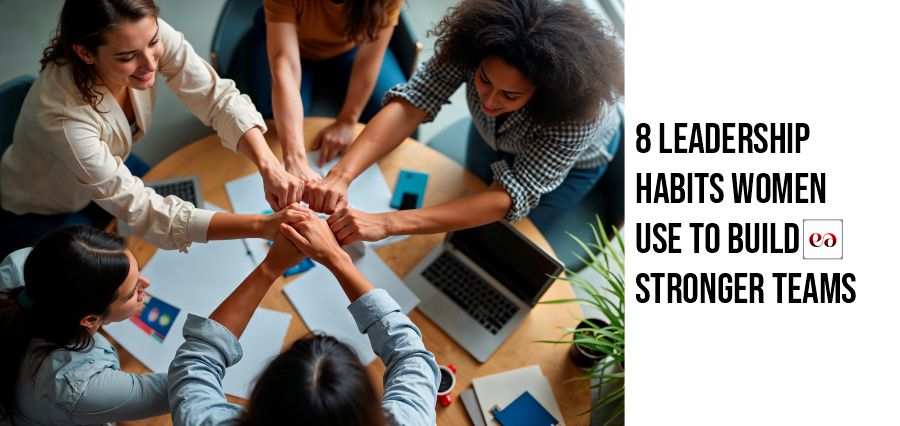
Strong teams do not happen by accident. They are shaped every day through decisions, communication, and the leadership habits that set the tone for how people collaborate.
Across industries, women leaders are often recognized for building teams that feel steady under pressure, connected in chaos, and high-performing without burnout. The truth is, these habits are not “soft skills.” They are strategic behaviors that directly impact trust, productivity, retention, and results.
Below are eight leadership habits women use to build stronger teams, along with practical ways to apply them immediately.
One of the most powerful habits women leaders practice is replacing micromanagement with direction. Strong teams do not need constant supervision. They need clarity: what success looks like, why it matters, and what the expectations are.
When leaders communicate clearly, the team spends less time guessing and more time executing.
Clarity reduces misalignment, prevents repeated work, and keeps the team focused on outcomes instead of tasks.
Clarity creates confidence. Control creates hesitation.
Women leaders often develop a skill that many teams are starving for: real listening. Not the kind where someone waits for their turn to speak, but the kind where they truly try to understand what is being said and what is being left unsaid.
This habit strengthens teams because employees feel heard, safe, and valued.
When people feel listened to, they stop working with fear and start working with ownership.
A strong team is not just skilled. It is safe. Women leaders often create environments where people can speak honestly, ask questions, and make mistakes without humiliation.
But safety does not mean a lack of accountability. The best leaders combine both: high trust and high standards.
Teams with psychological safety:
A team that feels safe becomes a team that moves faster.
Feedback is not just a management responsibility. It is a growth tool. Women leaders often approach feedback as development, not dominance.
Instead of making feedback personal, they make it precise. Instead of pointing out flaws, they show people how to improve.
Good feedback says: “This needs improvement.”
Great feedback says: “Here is what to fix, why it matters, and how to improve it.”
Use this structure:
Feedback should leave someone clearer, not smaller.
Women leaders often shift the spotlight away from themselves and toward the team. They do not lead to prove competence. They lead to build competence in others.
This is how strong teams are created: by developing leaders inside the team, not followers around the leader.
Empowered teams:
A leader’s job is not to be needed. It is to make the team capable.
When change hits, communication becomes leadership. Women leaders often maintain a steady rhythm of updates, check-ins, and honest direction even when not everything is figured out.
The team does not need a perfect plan every time. They need confidence that the leader will keep them informed.
Silence during uncertainty creates panic. Clear communication creates calm.
Consistency is what keeps a team emotionally stable while executing under pressure.
Strong leaders do not avoid uncomfortable conversations. Women leaders often address conflict with maturity by focusing on solutions and alignment instead of ego.
This habit protects teams from silent tension, gossip, and long-term resentment.
You can say: “I noticed a disconnect in the last project. Let us align on expectations so we can work smoothly.”
Strong teams do not avoid conflict. They manage it intelligently.
Recognition is not just about praise. It is about visibility. Women leaders often understand that people perform better when their efforts are seen, valued, and acknowledged.
The strongest teams are built when people feel their work matters.
Recognition improves:
Instead of saying, “Good job,” say: “Your preparation made that client meeting smooth and confident. You helped the team show up strong.”
People repeat what gets appreciated.
You do not need a promotion to lead better. These habits can be built at any level, whether you manage a team of 2 or 200.
Leadership is not one big moment. It is a pattern. Women leaders often build stronger teams because they lead with emotional intelligence, strategic clarity, and consistent support without losing standards.
If you adopt even three of these habits, your team will feel it:
Strong teams do not just follow leaders. They grow because of them.
Also Read : 9 Strategies Women Use to Lead Teams Through Pressure and Change




Welcome to the future of digital storytelling, where creativity meets innovation. We’re not just a magazine platform; we’re a team of passionate visionaries committed to transforming how stories are shared, celebrated, and experienced in the digital age. Join us as we inspire, inform, and redefine the world of digital magazines.
© Copyright 2025 | educationeureka | All Rights Reserved.