
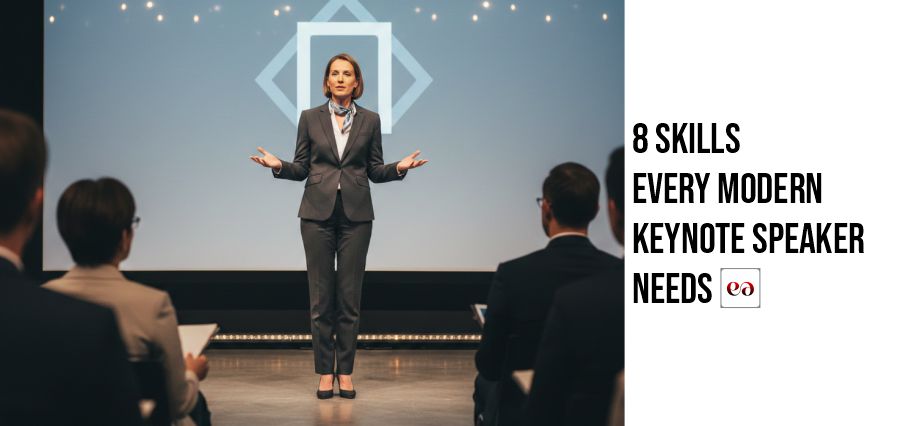
The keynote speaker role has changed. Audiences are sharper. Attention spans are shorter. Expectations are higher. A strong message alone no longer carries a stage. Delivery, relevance, and trust matter just as much as insight.
This article breaks down the eight skills every modern keynote speaker must develop to stay booked, remembered, and recommended. Each skill reflects what audiences and event organizers actively look for today.
Stories are not decoration. They are structure.
Modern keynote audiences do not want random personal anecdotes. They want stories that clarify an idea, reinforce a lesson, or shift perspective. Every story must earn its place.
Effective speakers design stories with intent:
The strongest stories feel personal without being self-centered. They sound honest without drifting into oversharing. When storytelling is strategic, the audience remembers the message long after the event ends.
If a story does not move the idea forward, it does not belong on stage.
No two rooms are the same, even when the topic is.
Modern keynote speakers read the room before they ever take the stage. They understand the audience’s industry, pressure points, language, and emotional state. They adjust tone and pacing in real time.
Audience intelligence includes:
This skill turns a prepared talk into a live experience. It signals respect. It builds trust fast. Speakers who master this never sound generic, even with a repeatable keynote.
Great speakers do not overwhelm. They organize.
Modern keynotes succeed because the audience can follow the logic without effort. Ideas unfold in a clear sequence. Each section builds on the last. Nothing feels scattered.
Strong message architecture includes:
Clarity is a competitive advantage. When audiences understand, they engage. When they engage, they remember. When they remember, they act.
Confusion is never a sign of depth.
Monotone delivery kills strong ideas.
Modern keynote speakers understand that emotion drives attention. They vary pace, volume, and tone with intention. They know when to pause. They know when to lean in.
Emotional range does not mean theatrics. It means alignment between message and delivery. Serious points land with gravity. Lighter moments offer relief. Silence is used as a tool, not a gap.
Audiences respond to speakers who sound human, not rehearsed. Vocal control signals confidence and presence. It keeps energy alive in the room.
Credibility today looks different than it used to.
Modern audiences distrust inflated titles and exaggerated claims. They respond to speakers who show expertise through insight, not status. Authority is demonstrated by how clearly someone thinks, not how loudly they assert.
This skill shows up through:
Authority without arrogance creates psychological safety. It invites the audience into the conversation instead of talking down to them.
Confidence that does not need to prove itself is the most persuasive kind.
Outdated examples lose rooms fast.
Modern keynote speakers constantly update their material. They track shifts in technology, culture, leadership, and work. They connect timeless principles to present-day realities.
Relevance comes from:
This does not mean chasing trends. It means anchoring insight in the world people actually live in. When audiences feel seen, they listen longer.
Presence speaks before words do.
Modern keynote speakers use their physicality with purpose. They understand how posture, movement, and eye contact influence perception. Nothing feels accidental.
Strong stage presence includes:
Distracting habits weaken credibility. Intentional body language strengthens it. When presence aligns with message, the speaker becomes believable before the first sentence lands.
A keynote without direction fades quickly.
Modern audiences expect more than inspiration. They want something to think differently about or something to do next. The best speakers leave the room changed, even in small ways.
A strong close offers:
The call to action does not need to be dramatic. It needs to be clear. When people know what to carry forward, the keynote continues beyond the event.
Impact is measured after the applause ends.
The modern keynote stage is crowded. Access is easier. Standards are higher.
Event organizers look for speakers who deliver value, not just performance. Audiences want ideas they can use, not speeches they forget. These eight skills separate professionals from placeholders.
They also compound. A speaker with clear message architecture becomes more powerful with strong storytelling. Authority grows when relevance is obvious. Presence amplifies emotional range.
Developing these skills takes intention, feedback, and refinement. The reward is longevity.
Keynote speaking is no longer about commanding attention. It is about earning it.
The speakers who thrive today respect their audience’s time, intelligence, and context. They prepare deeply. They communicate clearly. They show up fully present.
Master these eight skills, and the stage stops being a spotlight. It becomes a conversation that people are glad they stayed for.
Also Read : 8 Signs a Keynote Will Be Remembered Long After the Event



Welcome to the future of digital storytelling, where creativity meets innovation. We’re not just a magazine platform; we’re a team of passionate visionaries committed to transforming how stories are shared, celebrated, and experienced in the digital age. Join us as we inspire, inform, and redefine the world of digital magazines.
© Copyright 2025 | educationeureka | All Rights Reserved.