Helping businesses and nonprofits turn intentional giving into measurable growth, trust, and social impact!
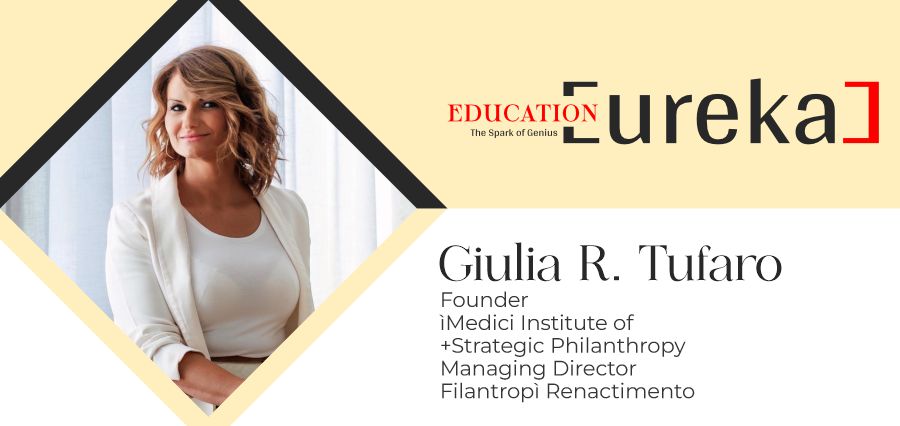
Many people chase achievements, climbing ladders, meeting targets, and collecting milestones. Success feels satisfying, yet at times, it leaves an emptiness, a sense that something deeper is missing. This feeling is familiar to Giulia R. Tufaro.
For years, she thrived in the world of marketing and digital sales. International projects, complex campaigns, and data-driven decisions filled her days. It was a world of energy, learning, and growth, yet each success carried a subtle question: what truly matters in the work she does and the life she leads?
By the age of 35, she felt the need to reconnect with the things that gave life meaning. Her journey began by revisiting her roots, exploring art, culture, and history, and reflecting on the values she grew up with. Growing up in Italy, she saw philanthropy as a natural part of life. Families and entrepreneurs supported communities. Volunteering created bonds. Acts of generosity were planned and thoughtful, designed to leave a lasting impact. These experiences shaped her belief that giving is both a responsibility and a way to build community.
Giulia began to blend these lessons with her professional skills. Philanthropy became more than a gesture of kindness; it became a strategy for growth and innovation. Each initiative she led aimed to create human and financial value while restoring purpose to daily work. By combining vision, planning, and empathy, she transformed her career into a path that brings meaningful change to others.
Her journey shows that success is not only measured by achievements but also by the impact left behind. By reconnecting with her heritage and values, she has found a way to bridge professional expertise with personal purpose. Through thoughtful action and a deep sense of responsibility, she demonstrates that life’s greatest accomplishments are those that lift others, inspire communities, and create lasting legacies.
Let us learn more about her journey:
Philanthropy as a Pillar of Business and Community
Giulia recalls reading about the Medici family during her school years, captivated by their ability to shape not just a city but an entire era. They acted as architects of influence, using relationships, ideas, and strategic giving to create lasting impact. Their power rested in vision and intention rather than titles or authority.
Years later, Giulia visited Florence as a researcher of meaning, studying the Medici legacy beyond admiration. She examined their entrepreneurial vision, political strategy, and use of patronage as a tool for growth. The houses they built, both literal and symbolic, fostered culture, reputation, commerce, and legacy. Within these structures lay the blueprint for a modern business model, one where philanthropy functions as a structural pillar, allowing companies to expand in revenue, reputation, and relevance through intentional giving.
From this insight, Giulia founded the ìMedici Medici Institute of Strategic Philanthropy and authored Philanthropy Path to Revenue Growth. For her, philanthropy has always been intertwined with art, culture, and community. Immersed in its value from childhood, she recognized giving as a form of leadership and a principle that informs modern business and governance models.
Redefining Impact: Collaboration Across Sectors
Companies and nonprofit organizations often make contrasting yet complementary errors in understanding philanthropy. Corporations frequently approach philanthropy, CSR, or ESG initiatives as a cost or a reputational exercise rather than as a strategic instrument for generating meaningful value. They focus primarily on the act of giving, while philanthropy, when guided by a clear vision, can serve as a catalyst for process innovation, cultural strengthening, and simultaneous social and economic impact.
Conversely, nonprofits and foundations frequently perceive philanthropy purely as fundraising, overlooking its potential for strategic partnerships and co-creation. By concentrating solely on sustaining their programs, they miss opportunities to form alliances capable of producing shared-impact systems.
Giulia facilitates collaboration between these two worlds, creating a space of mutual value. She applies the principles of Creating Shared Value, as outlined by Porter and Kramer, designing projects where economic and social success reinforce each other.
Her work emphasizes a shift in perspective: from “giving to help” to “collaborating to evolve.” When philanthropy becomes an integrated part of corporate strategy, and when nonprofits embrace the language of value and sustainability, initiatives emerge that benefit both sides. Enterprises gain reputation and trust, while communities increase their capacity and access to opportunity.
For Giulia, this represents the most authentic and contemporary form of strategic philanthropy.
Turning Strategic Giving into Growth Engines
In Philanthropy Path to Revenue Growth, Giulia presents sixteen international case studies demonstrating how philanthropy, when guided by strategic vision, can create measurable value for both businesses and their communities.
A striking illustration is TOMS, which embedded giving into its business model through the One for One approach: each pair of shoes sold generated a donation. This approach transformed philanthropy into a mechanism for global growth. Within a few years, TOMS donated over one hundred million pairs of shoes, opening new markets and fostering loyalty among a generation of ethically conscious consumers.
The same principle, philanthropy serving as a catalyst for trust, reputation, and revenue, is evident in companies such as Microsoft with AI for Good, L’Oréal with Women of Worth, and the Visa Foundation. In each case, social impact initiatives created long-term relationships, spurred innovation, and enabled access to new market segments.
Companies that invest in programs for inclusion, training, or empowerment have often experienced significant social impact alongside tangible benefits in reputation, talent retention, and organizational cohesion.
Balancing Purpose and Measurable Outcomes
Balancing values and results is one of the most delicate challenges of contemporary philanthropy. Giulia deeply defends the ethical and intentional value of giving, but today, goodwill alone is insufficient. Accountability, transparency, and the ability to speak the language of numbers are essential.
The Medici did not give out of charity but to build collective value. By supporting artists, scientists, and architects, they transformed generosity into cultural and political capital. Today, in a different way, Giulia does the same, translating intention into measurable strategies that generate reputation, trust, and sustainable growth.
In her work, she develops models that integrate impact indicators into financial language so that philanthropy is seen as a lever for development. She believes the future of philanthropy lies between heart and data, ethics and evidence, as the Medici once transformed beauty into lasting power.
Bridging the Corporate-Nonprofit Divide
The corporate and nonprofit worlds speak in different languages. While corporations focus on ROI, efficiency, and strategy, nonprofits emphasize social impact, values, and mission. Both aim for the greater good, yet their approaches and priorities often create misunderstandings.
Building real bridges requires mutual trust and structured dialogue. Giulia works with Filantropì Renactimento and the ìMedici Institute of Strategic Philanthropy to help companies, foundations, and nonprofits form sustainable alliances. In these partnerships, philanthropy becomes a shared language of growth and innovation.
Through her “4 Houses Framework,” Giulia guides organizations to create shared spaces where business logic and purpose intersect. Each house represents a dimension of strategic philanthropy: the Villa focuses on culture and talent, the Palazzo on leadership and engagement, the Signoria on reputation and partnerships, and the Bank on growth and innovation.
When these dimensions align, differences transform into complementarities, and collaboration between profit and nonprofit evolves from a challenge into a powerful engine of systemic impact.
Purpose-Driven Growth
Giulia explains that the most important mindset shift for executives is moving from giving to building value. She emphasizes that philanthropy is a strategic investment in reputation, human capital, and the future. She invites today’s executives to rethink philanthropy as an engine of innovation and legitimacy, capable of strengthening brands, attracting talent, and building lasting relationships.
Inspired by the Medici and her Italian heritage, Giulia often speaks of a new form of Renaissance leadership, where power is measured by the ability to generate impact rather than possession. She notes that Cosimo de’ Medici understood this centuries ago: supporting art, culture, and knowledge meant building a legacy that would sustain trust and influence for generations.
Cross-Sector Collaboration Unlocks Innovation
Each sector possesses unique resources: the capital of companies, the local knowledge of NGOs, and the legitimacy and long-term vision of institutions. When these competencies meet, they produce solutions no single sector could achieve alone.
Cross-sector collaboration allows for the union of capital, knowledge, and trust, creating systemic and lasting impact. In the projects developed with Filantropì Renactimento and the ìMedici Institute of Strategic Philanthropy, it is often observed that the most authentic innovation emerges where the barriers between profit and nonprofit dissolve, and where philanthropy becomes the shared language connecting economic and social objectives.
Storytelling and Communication in Scaling Nonprofit Impact
Storytelling serves as one of the most powerful tools in philanthropy. It transforms impact into emotion and trust, allowing donors to see themselves as an integral part of the journey. Numbers and statistics gain meaning and create a sense of belonging through compelling narratives.
Giulia experienced this firsthand while collaborating with an exceptional corporate storyteller from Geneva, Robert Bartram, who introduced her to the Hero’s Journey, a model widely applied in nonprofit storytelling. A striking example of this approach is the British NGO CAFOD’s project, A Journey in the Dark – A Boy’s Struggle to Stay in School in Uganda. CAFOD’s initiatives bring vital change to lives, ensuring that communities in remote areas of Africa have access to water and dignity.
Transforming Leadership Through Experience
Giulia has witnessed managers and teams transformed by direct experiences of impact. There were a series of experiences over the years that showed her how philanthropy can transform leadership, loyalty, and organizational culture.
During the research for her book Philanthropy Path to Revenue Growth, and in her work as Fundraising Director at The Social Incubator, she observed this transformation many times: when corporate leaders acted as mentors or volunteers, during inspirational days, sports and inclusion projects, or exploratory visits where the corporate world met young people. In those moments, individuals accustomed to leading through numbers and performance reconnected with their human and professional purpose.
She found the same spirit in companies such as Patagonia and Salesforce, cited in her book, where social engagement generated impact while strengthening internal cohesion and team loyalty.
These experiences taught her that philanthropy, when lived rather than merely managed, forms the internal culture of organizations, builds identity and trust, and encourages a shared sense of purpose. In those moments, generosity becomes leadership, and leadership becomes legacy.
Envisioning the Future of Strategic Giving
Giulia imagines philanthropy as a stable presence in boardrooms, no longer a marginal budget line but a strategic lever for growth, expansion, and reputation, capable of attracting and retaining talent and guiding strategic decisions alongside marketing or innovation.
She foresees companies and nonprofits co-developing a common framework for impact measurement, integrating quantitative and qualitative metrics, so that social value becomes comparable, transparent, and economically recognizable. She also envisions a European donor portal, a shared platform allowing nonprofits to report in real time, fostering trust, accountability, and new cross-sector collaborations.
For her own vision, Giulia aims to grow the ìMedici Medici Institute of Strategic Philanthropy into a European pillar of research and education, and, with ambition, to become the mother of modern philanthropy, helping to raise a new generation of leaders who see philanthropy as a strategy for the future.
Authentic Integration of Giving in Business
Giulia believes that the first step for emerging leaders is to ask themselves why they want to contribute and what kind of future they wish to build.
She explains that authentic philanthropy is born from responsibility, imagining a different world, and acting to create it. Today, in every boardroom, there is a new player at the table: society itself. It holds influence equal to shareholders and clients and deserves recognition as part of strategic decisions.
Giulia suggests that those beginning this journey involve their teams, avoiding the delegation of philanthropy to marketing, and instead living it as part of corporate culture. She emphasizes measuring human impact before economic impact, because lasting value begins there.
Finally, she encourages studying history and learning from those who changed the world before us. Giulia reflects on the Medici family, who united power, culture, and vision to create an influence that endures for centuries. She believes this is the level of ambition leaders should cultivate: creating value while leaving a meaningful mark.
Building a Legacy of Enduring Impact
Giulia wants to help shape a new generation of Renaissance leaders, capable of uniting art, business, and impact, and of seeing philanthropy as a strategy for growth and meaning.
If she can leave behind a method that helps transform generosity into lasting value for people and organizations, then she will have fulfilled her mission.
LinkedIn:
https://www.linkedin.com/in/dr-giulia-r-tufaro/
https://www.filantropirenactimento.com/
https://www.filantropirenactimento.com/book
Dr. Giulia R. Tufaro is the author of Philanthropy Path to Revenue Growth and creator of the 4 Houses Framework for Strategic Philanthropy. Through her Medici-inspired approach, she helps business and nonprofit leaders align purpose, culture, and growth. Her work connects Renaissance heritage with modern corporate strategy, building a bridge between art, business, and impact.