
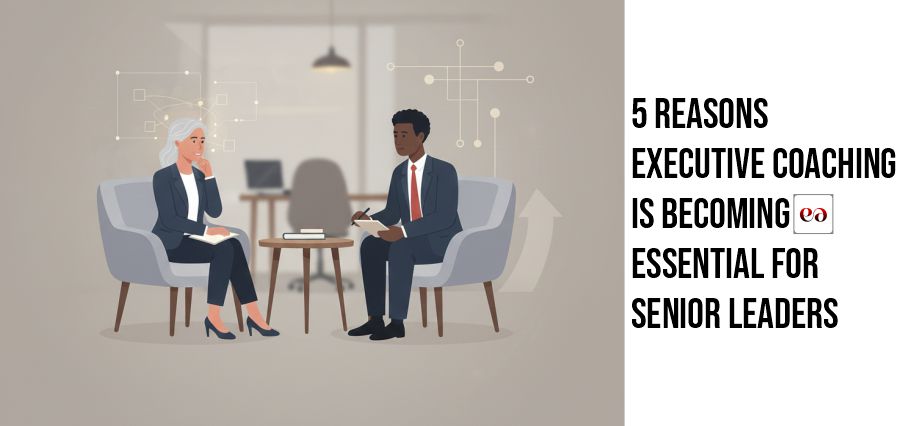
Executive leadership used to be about authority, experience, and decisiveness. That model no longer holds on its own. Senior leaders today are expected to navigate complexity, lead through uncertainty, and perform under constant scrutiny. The margin for error is smaller, and the human cost of leadership mistakes is higher.
This shift explains why executive coaching has moved from a discretionary perk to a strategic necessity. It is no longer remedial. It is developmental, preventative, and performance-driven. Leaders who invest in coaching are not fixing weaknesses. They are strengthening capacity.
Below are five clear reasons executive coaching is becoming essential for senior leaders, with practical insight into why this trend is accelerating and why it matters now.
Experience used to be enough. Today, it is not.
Senior leaders are operating in environments shaped by rapid technological change, distributed teams, cultural shifts, and constant market volatility. Past playbooks no longer apply cleanly. Decisions require balancing speed with judgment, empathy with authority, and innovation with risk management.
Executive coaching helps leaders adapt their thinking rather than rely on outdated habits. A skilled coach challenges assumptions, surfaces blind spots, and helps leaders reframe problems from multiple angles. This creates mental agility, which is now a core leadership skill.
The real value lies in perspective. Coaching gives leaders a structured space to slow down their thinking, examine complexity without pressure, and make better decisions when it matters most.
Experience teaches what worked before. Coaching prepares leaders for what has not happened yet.
At the senior level, technical competence is assumed. What differentiates effective leaders is self-awareness.
How a leader shows up under stress, how they communicate power, how they handle disagreement, and how they respond to feedback directly affects organizational culture and results. These behaviors are often invisible to the leader themselves.
Executive coaching creates a feedback loop that most senior leaders lack. Direct reports filter information. Boards focus on outcomes. Peers compete for influence. A coach provides unfiltered, objective insight grounded in observation and evidence.
Through coaching, leaders learn to recognize patterns in their behavior and understand the impact of those patterns on others. This awareness leads to better relationships, stronger trust, and more effective influence across the organization.
Self-awareness is not soft. It is operational. Leaders who understand themselves make fewer costly mistakes and build teams that perform without fear.
Emotional intelligence used to be optional. It is now foundational.
Senior leaders set the emotional tone of the organization. Their reactions during crisis, their listening habits, and their ability to regulate stress ripple through teams. Low emotional intelligence increases burnout, disengagement, and attrition. High emotional intelligence strengthens resilience and performance.
Executive coaching focuses deeply on emotional regulation, empathy, and communication under pressure. Leaders learn how to pause before reacting, how to navigate difficult conversations, and how to lead without dominating.
This matters because modern organizations depend on collaboration rather than command. Influence travels sideways and downward, not just from the top. Leaders who lack emotional intelligence struggle to mobilize people, even when strategy is sound.
Strong leadership is not about intensity. It is about presence.
The higher leaders rise, the fewer places they can speak freely.
Senior executives carry confidential information, high-stakes decisions, and personal doubts they cannot easily share. Over time, this isolation erodes clarity and increases cognitive load. Leaders may appear confident while internally carrying unresolved tension.
Executive coaching provides a confidential, judgment-free space for reflection. Leaders can explore concerns, test ideas, and process pressure without political consequences. This psychological safety is rare and valuable.
Coaching also reduces the risk of reactive leadership. When leaders do not have an outlet for reflection, stress leaks into decisions and relationships. A coach helps leaders process complexity before it turns into impulsive action.
Isolation is not a personal failure. It is a structural reality of senior leadership. Coaching addresses it directly.
The expectation that leaders arrive fully formed is outdated.
Boards, investors, and stakeholders now expect senior leaders to demonstrate growth. Adaptability, learning mindset, and openness to feedback are viewed as indicators of long-term leadership viability.
Executive coaching signals commitment to development. It shows that a leader takes responsibility for their impact and performance. This is especially important during transitions such as role expansion, organizational change, or crisis leadership.
Coaching supports leaders through these moments by helping them recalibrate identity, redefine priorities, and align behavior with new expectations. Without this support, even highly capable leaders can plateau or derail.
Continuous evolution is no longer optional. It is the baseline for credibility at the top.
Traditional leadership training often fails senior leaders because it is generic. Coaching works because it is personal, contextual, and adaptive.
A coach meets the leader where they are. Sessions focus on real challenges, real decisions, and real consequences. Progress is measured not by theory learned but by behavior changed.
Coaching also respects the leader’s intelligence. It does not prescribe solutions. It sharpens thinking. This approach builds ownership and lasting transformation rather than compliance.
The result is leadership that feels grounded, intentional, and sustainable.
Organizations that invest in executive coaching see measurable returns. These include stronger decision quality, improved team engagement, higher retention of key talent, and more effective change leadership.
The cost of coaching is small compared to the cost of executive failure, cultural damage, or stalled strategy. More importantly, coaching extends the productive lifespan of senior leaders by preventing burnout and stagnation.
For individual leaders, coaching increases confidence without arrogance and clarity without rigidity. It helps leaders lead from alignment rather than reaction.
Executive coaching is becoming essential because leadership itself has changed. The role now demands psychological depth, emotional intelligence, and continuous adaptation. These qualities do not develop by accident.
Coaching gives senior leaders the one resource they rarely have time to create on their own: structured reflection that leads to better action.
Leaders who embrace coaching are not behind. They are ahead. They understand that the future of leadership belongs to those willing to examine themselves as seriously as they examine the business.
That is not weakness. It is modern leadership at its strongest.
Read also : Evan Tzivanakis: Transforming Strategy into Action and Executive Excellence





Welcome to the future of digital storytelling, where creativity meets innovation. We’re not just a magazine platform; we’re a team of passionate visionaries committed to transforming how stories are shared, celebrated, and experienced in the digital age. Join us as we inspire, inform, and redefine the world of digital magazines.
© Copyright 2026 | educationeureka | All Rights Reserved.