
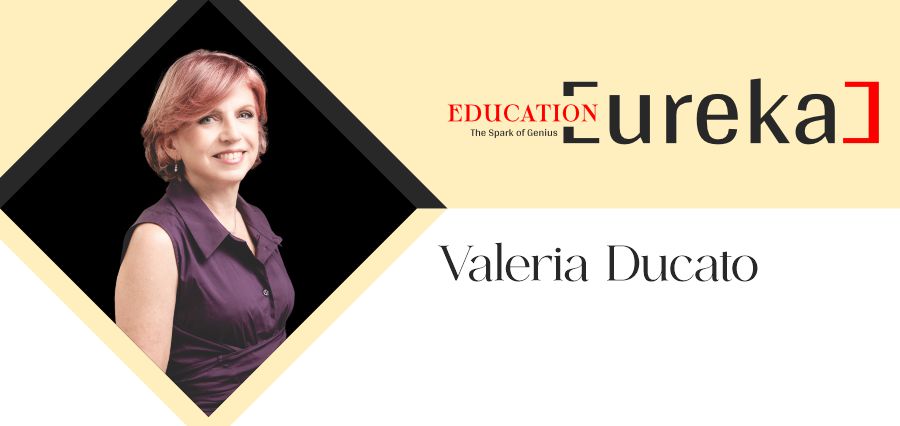
Architecture to stage to storytelling. A voice that turned every chapter into purpose.
People who step into acting or comedy often start with a simple love for lightness. Valeria Ducato felt this early. As a young girl, she loved seeing the funny side of situations. She said it herself: I was always the one at home who played pranks or defused tense situations. Her voice soon became her preferred channel of communication, and that connection opened the door to a dream. She began to imagine a future as an actress and a comedian.
That dream lived inside her, yet the world around her carried another story. She shared that at the time, there were many prejudices about people who did this job, and I listened to too many voices. Those opinions formed her choices. Fear became louder than desire, so she followed the safer path and chose university. Days moved on, and something inside her grew heavier. She said it clearly: When you betray yourself, you always feel unhappy. That feeling deepened as she walked further from the life she wanted.
As graduation approached, others felt close to a finish line. Valeria felt something very different. She says, instead of feeling close to a goal, I felt increasingly trapped. That pressure led her to a powerful point of clarity. She reached a point where she felt she had nothing left to lose, and she describes it as a privileged moment, because it allowed her to be fully authentic again. She no longer tried to please anyone. She chose honesty. She chose courage.
So, she took her first step. She completed her degree in Architecture, earned a diploma in acting in Milan, and entered the world she had always imagined. She worked as an actress, a voice actress, and a commercial speaker, and later became an author. She appeared in theater and became a steady voice in renowned advertising campaigns for Ferrero, Findus, Baci Perugina, Sammontana, Ferrarelle, and many more.
Her journey started the day she allowed her true voice to rise.
Below are the interview highlights:
This has always been clear to me, and it is precisely what has always fascinated me: the voice draws from our unconscious and speaks to the unconscious of the listener. It is an open book, even if you are not aware of it.
Think about how much information the voice conveys. Even from a simple, distracted “Hello,” we can tell if something has happened to someone. The voice arouses emotions; it is capable of evoking feelings. Think about when we hear a recording of someone who is no longer with us; how it immediately moves us.
In advertising, I have always worked officially with voiceovers and unofficially with scripts (I have never signed a directing credit). Architecture gave me discipline and method in achieving a goal. An architect has to consider many variables: who will live there, how your work fits into the city, how it changes habits or traffic… so it taught me to see projects in their entirety, throughout their entire process.
My strategy has always been this: one sector complements the other. Theater gave me the opportunity to analyze texts and investigate characters, digging deep within myself to make them believable.
This introspection has also been useful in my work as an author.
Advertising, on the other hand, is always a challenge: in 30 seconds, you have to convey a character or an atmosphere, you have to move people emotionally. It taught me the gift of synthesis, which I later found to be fundamental in comic writing. Teaching, then, is the completion of everything, where you have to bring everything together. I am a slasher; I couldn’t have drawn from just one field: I have been involved in many and they have all been synergistic with each other.
When you rediscovered Luisa Spagnoli’s story for Radio24, what did you feel about bringing forgotten histories to life, and how has that shaped your perspective on storytelling?
You know, in my latest show and in my novel Dove altro devi andare, I say that sometimes you can’t find substitutes. Certain things are asked of you specifically. You have to take responsibility for them.
That’s what happened with Spagnoli: I felt that I had to do it.
I discovered this story while I was on vacation in Tuscany, in one of those beautiful farmhouses in the countryside that have been converted into hotels, where you sometimes find books for tourists. One spring afternoon, I read the story of Luisa Spagnoli, summarized in just a few lines. At first, I thought it was fake news. It was paradoxical that no one knew her, that the two companies she founded, Perugina and Luisa Spagnoli, did not promote her, nor did they exploit the situation for commercial purposes.
Luisa was courageous, daring, authentic, and thought outside the box. An entrepreneur, a woman, and mother, she was silenced by a fascist regime because she was annoying, at a time when it was convenient for women to be submissive and silent. She was a model of womanhood that fascinated me, very modern, someone I would have liked to resemble.
It was a story about resourcefulness, strength, but also courage and forgiveness. She never betrayed herself; she always looked at herself with audacity, facing many challenges, going against the grain, trying to build rather than destroy or defend herself.
She seemed to me to be a great example of femininity. I had absolutely no intention of writing, but that day I said aloud: This story needs to be told. A year later, unable to tour with the theater because I was a new mother, I joined the editorial staff of Destini Incrociati. I liked that format; I found it very inspiring. It told the story of how two characters, having crossed paths, created something unique. Spagnoli would have been perfect! So, I suggested her, and it was such a success that Rai used that episode as the basis for the TV series.
That year, at Christmas, I voiced the Bacio Perugina advert: I think Luisa thanked me from above in that way!
I believe that the time has come for us women to be aware of our talents and the added value we can bring. They made us believe that we were weak, fragile, and lacking leadership skills. But today, submission is called flexibility, emotionality, empathy, and submissiveness is called resilience. Today, however, these have become skills that human resources departments in companies seek when reviewing résumés.
These are all characteristics that come naturally to us women.
We are not “otherwise men”. We are women. I want to be a woman without giving up the most authentic characteristics of femininity. In my show, these women are different in age, culture, and social class, but they are all real and therefore vulnerable. That is why they arouse dismay, sympathy, tenderness, anger, amazement… from time to time.
In the final monologue, I say that we are all mothers, some without ever having given birth, because being a mother is a space in the heart. I also say that: We are all like this: focused on building, rebuilding on scorched earth, on recently burned skin, on secret pains, on humiliations drawn by history.
In pursuit of that vital breath that generates and regenerates, repairs and rebuilds. But always gently attached to life. I believe that each of us finds ourselves in situations in life that make us believe we are alone and have missed the boat, but, in truth, we are all like that. When you accept this, then you discover your power and your value.
Now I can say that I understand with all my heart that nothing happens by chance. My work is wonderful because it transforms pain, sublimates it, and thus helps you overcome it, find the right compassion for yourself and others.
I had to learn to forgive those who hurt me; it wasn’t an easy journey, but art helped me a lot. By telling others about it through art, everything became clearer and more bearable, and I became stronger. I have always wanted pain to become a value in my life and in my art, to be transformed, to make me more sensitive, human, and profound. Or more empathetic and generous, as a teacher.
This is a very specific question. Even in the recording studio, this precision is needed. You need to achieve total control over your voice, and this is achieved through technique and experience. It also requires a lot of discipline.
In other words, you need to reach the point where the voice that comes out corresponds exactly to what you wanted to come out. To express something, you need to achieve this control: then you can give space to nuances and intuitions, which build the character, serve the situation, and add value. Never go in blind, and never use clichés.
Here we enter a minefield: the definition of success.
Of course, success is flattering, but lately, expressing myself has been more fulfilling. The game is played with myself: Does what I do correspond to who I am? That is the real question. I believe that each of us has a mission, a task on this earth, and I want to accomplish mine.
Well, there have been several. Challenges intrigue me, as I recount on my website: the first was refusing to become an architect, despite having a degree. It was a huge scandal for everyone.
It was very difficult; everyone was against me, and I had no financial resources, but this prevented me from settling into a comfort zone.
It was perhaps one of my first courageous choices. You know, you train yourself to be courageous. Another big challenge was writing the book I Jalisse: che fine hanno fatto.
I had never published anything before, I didn’t know the singing duo, and the publisher had only given me 20 days. But I had faith in myself and felt that I would do a good job. So, I wrote constantly, without looking at the clock, eating when I felt hungry, and sleeping only a few hours when I couldn’t take it anymore.
I realized that with a client and the right amount of pressure, I perform at my best. I also learned that I need to be smarter when it comes to deciding on fees, so now I’ve delegated that task to someone else.
By listening. I always try to put myself at the customer’s service, on the same wavelength, to understand what they want and what they may not even know they want. It’s not a rational process; it never goes through your head, you activate something else.
Often, the client tells you about an intention, an idea, a desire, and you have to propose solutions, open up avenues, show scenarios. Then I always try to ask myself what added value I could bring; in short, I try to bring out my uniqueness.
In the theater, I say you have to give the audience a good reason to pay for a ticket. In the recording studio, you always have to give added value that justifies your presence. So you dig into your most intimate, most unique part. You must never be repetitive, never use clichés; in the long run, they don’t pay off. It’s very tiring work for an actor, but very fascinating.
As I said before, courage is something you have to train. Life presents us with small steps, small crossroads: in the choices you make in those moments, you train yourself, so that when the real crossroads come, you find the courage that you have slowly built up.
New challenges, whether proposed to or ones I have taken on myself, have always intrigued and amused me, rather than frightened me. I believe this is the key. The rest has always come naturally, but always in the service of various fields. I have always had faith in this process.
I say that we women should no longer ask for respect or claim rights. These are provocations, and they shift the problem. Respect and rights will have consequences. We will obtain them automatically when we allow ourselves to be women and not “otherwise men.” We must validate ourselves. We must be aware of this and take responsibility for having within us the codes that, at this moment in history, make and will make a difference. We need to redesign the paradigms.
In the film Coach Carter, there is a character who says: We are born to manifest the glory that is within us, it is not just in some of us, it is in all of us. If we let our light shine, we unconsciously give other people permission to do the same. As soon as we free ourselves from our fear, our presence automatically frees others.
That sums it up perfectly.
Read Also : Spotlight on Italy’s Most Admired Keynote Speakers of 2025–26




Welcome to the future of digital storytelling, where creativity meets innovation. We’re not just a magazine platform; we’re a team of passionate visionaries committed to transforming how stories are shared, celebrated, and experienced in the digital age. Join us as we inspire, inform, and redefine the world of digital magazines.
© Copyright 2026 | educationeureka | All Rights Reserved.