
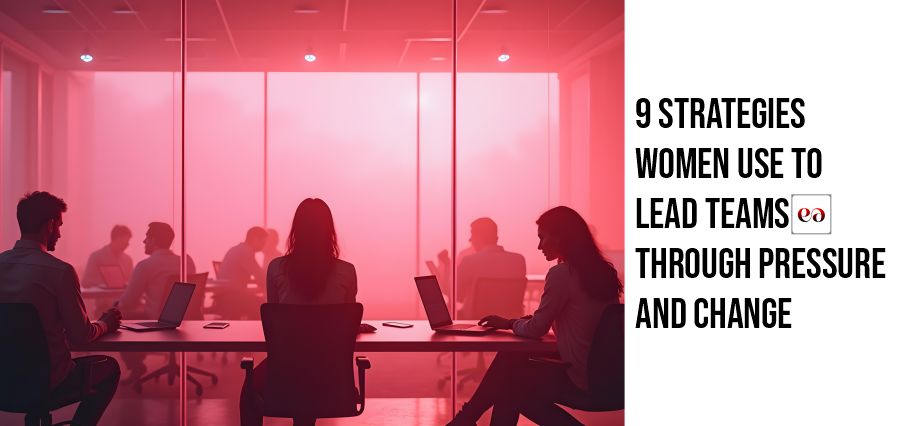
Pressure changes people. It reveals who stays steady, who panics, who freezes, and who rises. In today’s workplace, teams face constant disruption: tighter deadlines, shifting priorities, layoffs, restructures, rising customer demands, and rapid technology adoption. In the middle of all that, leadership is not just about performance. It is about direction, emotional control, and decision-making when there is no perfect answer.
Women leaders across industries have built a strong reputation for guiding teams through uncertainty with clarity and resilience. They lead with empathy, yes, but also with execution. They can hold the line when necessary, communicate hard truths without damaging morale, and keep people focused when everything feels unstable.
This article breaks down nine practical strategies women use to lead teams through pressure and change, without burning out their people or losing momentum.
Pressure and change create a unique workplace risk: confusion. When teams do not know what is happening, they start creating stories in their heads. Productivity drops, trust gets shaky, and engagement fades.
Great leaders do the opposite. They simplify complexity. They offer stability without pretending everything is fine. They guide teams through transition with a structure people can rely on.
And that is exactly where these strategies shine.
Calm leadership is not silence. It is emotional regulation.
Women leaders often manage pressure by controlling their own energy first. They do not dump anxiety on the team, and they do not dramatize uncertainty. Instead, they show steadiness and composure, which gives others permission to stay grounded too.
In chaotic moments, teams look to leaders as emotional reference points. A calm leader signals safety, and safety improves decision-making.
Many leaders wait until they have the perfect message. The problem is, teams cannot wait that long. Silence creates anxiety, and anxiety kills focus.
Women leaders are often strong at proactive communication. Even when they do not have every answer, they communicate what they know, what they do not know, and what happens next.
Use simple language during uncertainty. Complexity confuses people. Clarity calms them.
Pressure multiplies when everything feels urgent. During change, teams often get overloaded with shifting tasks and unclear expectations. One of the strongest strategies women use is protecting focus.
They do not let the team drown in the noise. They reduce the workload to what truly matters now.
These are the outcomes that cannot fail: deadlines, customer commitments, compliance, product delivery.
Anything that does not move the goal forward gets delayed, delegated, or removed.
High-performing teams do not chase 15 priorities. They execute 3 with excellence.
Focus creates momentum. Momentum creates confidence. And confidence lowers stress.
When change hits, people do not only worry about work. They worry about stability, roles, recognition, and job security. This is where leadership trust becomes everything.
Women leaders often build trust through consistency, not grand speeches.
Not your title. Not your strategy document. Your behavior under pressure.
During pressure and change, one-way communication fails. Leaders talk, teams listen, and nothing improves. Women leaders often lead better change management because they actively listen and adapt.
They do not treat feedback as a threat. They treat it as intelligence.
Instead of “Any questions?” ask:
People speak up when they feel safe. This requires leaders to respond without punishment.
Feedback is useless if nothing changes. Even small improvements signal respect.
Empathy is sometimes misunderstood as being soft. In reality, empathy is clarity with care.
Women leaders often balance compassion with accountability. They recognize stress and personal strain, but they still protect performance and standards.
“I understand you. And I still believe you can rise to this.”
That mindset builds stronger teams than fear ever can.
Change demands decisions. Delayed decisions create bottlenecks. Bottlenecks create frustration. And frustrated teams eventually disconnect.
Women leaders often improve decision speed by involving the right voices early, then making the call with confidence.
Collect key facts from team members closest to the work.
Not every decision needs consensus. It needs ownership.
People accept hard decisions when they understand the reasoning.
Speed creates stability. Teams can handle tough decisions. They struggle with uncertainty.
During pressure periods, the team does not need more motivation. They need better energy management.
Women leaders often pay attention to early signs of burnout: irritability, low creativity, missed deadlines, disengagement, silence, and constant fatigue.
Burnout does not happen overnight. It builds silently. Strong leaders notice patterns early and act before collapse.
The best leaders do not just survive change. They grow people through it.
Women leaders often reframe pressure as an opportunity to build capability across the team. Instead of treating disruption like a threat, they use it to create leadership moments for others.
Ownership builds confidence. Tasks build dependency.
Let team members practice making calls, not just following instructions.
When people feel seen, they perform better under stress.
Teams that grow through change become stronger, faster, and more adaptable long-term.
Pressure and change are unavoidable. What separates average leaders from outstanding ones is how they show up when the path is unclear.
The strategies women often use are effective because they blend two things most teams need most:
They lead through people, not around them. They communicate with intention. They prioritize what matters. They protect focus and wellbeing without sacrificing performance.
And most importantly, they create a team culture where pressure does not break people. It shapes them.
Businesses are evolving faster than ever. Teams will face more change, more complexity, and more pressure in the years ahead. Leadership will no longer be judged only by results. It will be judged by how those results were achieved and what the team looked like after the storm.
If you lead a team today, start with one shift: choose calm, clarity, and consistency when pressure rises.
That is how trust is built. That is how teams stay strong. That is how leaders grow.
Because change is not the real challenge. Confusion is.
Also Read : Lana Zivanovic: Advancing the Science Behind Better Food