
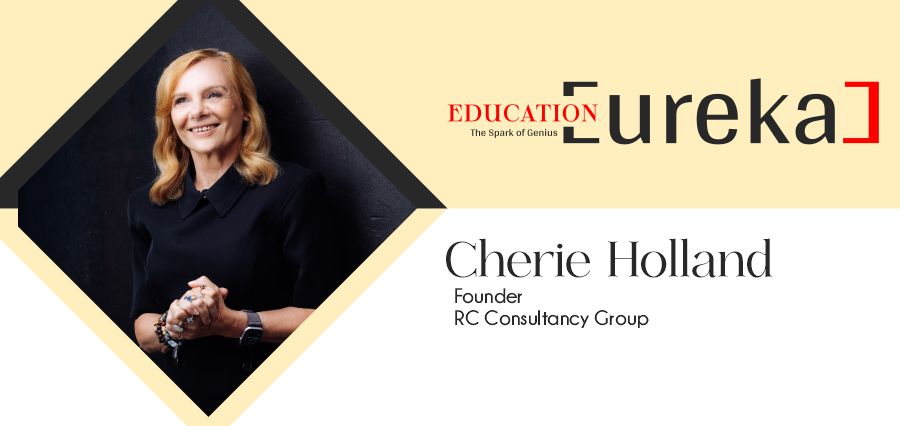
Guiding workplaces as living communities where people grow together!
Some memories rise with a soft ache. A desk lamp, murmured voices, the gentle comfort of shared work. For Cherie Holland, those early scenes inside her family business carried warmth and order, yet they also raised a question that stayed with her: What should real leadership stand for, and who gets to carry it?
In that world, men often held decision-making roles. Women filled secretarial and administrative roles, these being nurses or assistants but not key roles such as doctors or lawyers. The pattern reflected the era, and it stirred something inside her, asking whether leadership could mean more than status or position.
Through her family, Cherie met highly successful figures across the Australian business community. She listened, observed, and felt how choices flowed outward into teams and homes. Strategy mattered, yet the human side carried greater weight. She sensed that organisations came alive through people, behaviour, and values travelling through everyday actions.
Study and professional experience added new insight. A clearer truth emerged: Leadership finds its strength when it lifts people, opens opportunity, and helps lives move toward change that feels good and fair. Titles alone could never carry that work. This belief guided her toward leadership and organisational development, where she could help others learn, adapt, and grow with purpose.
Cherie began to see workplaces as communities. She speaks with calm conviction about stewardship. Each of us belongs to two families: the one that raises us, and the one we build through our work. Each deserves care, structure, accountability, and respect. Leading a company becomes a chance to build an environment where people develop, contribute, and feel a strong sense of belonging.
The stakes feel real. When leaders fail, trust weakens, voices fade, and potential remains unseen. When leaders care, people rise, teams steady, and lives change.
Every community brings many voices. Gentle collaborators, bold dreamers, careful planners, and colleagues who challenge ideas all sit at one table. Some moments feel demanding, yet Cherie sees energy in that mix. Diversity encourages balance, widens thinking, and leads to wiser choices that honour everyone involved.
Today, Cherie continues this work as a leader, consultant, and coach. She builds spaces where care stands beside clarity, and where growth feels human. Success lives in people who find confidence, purpose, and dignity. Her journey began in a family business setting and now continues in workplaces treated as true communities, held with purpose, respect, and a steady commitment to helping others flourish.
Let us learn more about her journey:
Leadership across borders often looks different from how textbooks describe it. Cultural context forms how teams engage, trust, and deliver results. Without that awareness, even strong strategies stumble.
Working across 6 countries and multiple industries fundamentally reformed how Cherie understands leadership. Early in her global career, she learned that effective leadership is not universal. It is deeply contextual. What motivates, inspires, or challenges people in one country may not translate in another, and assuming it will often leads to unintended consequences.
This exposure made cultural intelligence essential rather than optional. She learned to listen first, observe carefully, and understand local dynamics before making decisions. Strategic initiatives that ignore cultural nuance, no matter how well designed, tend to falter because they fail to engage the very people responsible for delivering them.
Over time, she came to see leadership as inherently relational. It requires humility, adaptability, and a genuine respect for difference. Some of her most effective decisions were shaped not by imposing external models, but by co-creating solutions with local leaders, teams, and communities who understood their context far better than she ever could alone.
Today, cultural intelligence is embedded in everything she does, from how she designs leadership programs and advises boards to how she coaches executives operating in complex, global environments. Sustainable strategy only succeeds when it resonates with people, honours context, and reflects the reality of those expected to bring it to life.
Tough markets expose who the leaders are beneath the titles. When industries collapse, many default to survival mode.
Cherie took a different path.
In the early 2000s, Australia’s manufacturing sector experienced a significant downturn. At the time, she was the CEO of a manufacturing and engineering company based in Brisbane, employing more than 30 people. Many competitors responded by rapidly downsizing their workforce to preserve short-term cash flow.
Her priority, however, was to ensure their people continued to be paid while the organisation navigated the uncertainty ahead. She believed that ethical leadership is tested most when pressure is high, and that decisions made in these moments define organisational character. Rather than viewing the workforce as a cost to be reduced, she viewed it as a capability to be protected.
This decision was not without risk. Retaining the team required careful financial management and difficult trade-offs. However, it proved to be a defining strategic advantage. As market conditions began to stabilise, competitors who had significantly reduced their workforce lacked the capacity and technical depth to respond to larger, more complex projects. Her organisation, on the other hand, was fully resourced, experienced, and ready.
The outcome was twofold. Internally, workforce loyalty and engagement increased significantly, creating a culture of trust and commitment. Externally, they secured substantial projects that others could not service, strengthening both revenue and reputation. This experience reinforced her belief that ethics-first decisions are not opposed to commercial success. They often enable it. When leaders choose to protect people, they also protect the long-term viability of the business.
Real innovation often starts with pressure. Limited budgets, market barriers, and operational strain force leaders to think differently. That is where Cherie thrives. Her creative process is driven by necessity, discipline, and collaboration rather than abstract ideation. She is most innovative when faced with real constraints, financial pressure, operational inefficiency, or environmental complexity, because those conditions demand clarity of thinking and practical solutions.
Following the Global Financial Crisis, she was a Director and CEO of a newly established company operating in a highly constrained Australian market. Growth opportunities were limited domestically, but an opportunity emerged in South Africa. The contract was commercially lean, and the unfavourable exchange rate created a significant cost barrier. Traditional delivery models would not have been viable.
Applying a lean manufacturing and management lens, she stepped back to analyse the entire value chain, where cost was incurred, where inefficiencies existed, and where technology could be leveraged to decouple productivity from physical presence. Working closely with her leadership and engineering teams, she explored how remote capability could improve both operational control and output in overburden removal.
This collaborative process led to the design and development of A Remote Overburden Mine Operations Monitoring and Assistance System. The solution fundamentally changed how production was managed, enabling real-time oversight, improved decision-making, and operational consistency without proportional increases in on-site cost.
The impact was measurable and transformative. The system doubled production output and significantly improved mine operations, moving the site from the worst-performing to the top-performing mine within eighteen months. It also became a patented innovation across multiple jurisdictions.
This experience reflects how she nurtures innovation: by identifying genuine operational pain points, applying structured thinking, engaging multidisciplinary teams, and remaining focused on solutions that deliver tangible, scalable outcomes. For her, innovation only matters when it improves performance, resilience, and real-world results.
Large teams, multiple locations, shifting expectations. Trust becomes currency. Cherie treats it as something built deliberately. Trust is built through consistency, transparency, and accountability. She is intentional about aligning words with actions and ensuring decision-making processes are clearly communicated.
Collaboration across borders requires psychological safety; people must feel heard, respected, and valued. She prioritises inclusive leadership practices that invite contribution while setting clear expectations and boundaries.
Another key principle is shared ownership. When stakeholders understand the why behind decisions and see how their role contributes to collective success, collaboration becomes a natural outcome rather than a forced one.
Transformation can be disruptive. When handled poorly, it erodes loyalty. When guided thoughtfully, it strengthens organisations.
Cherie believes efficiency without empathy erodes trust, while empathy without structure stalls progress. The balance lies in recognising that people experience change emotionally before they engage with it operationally.
She applies lean principles to remove unnecessary complexity, but she pairs them with intentional communication, coaching, and support. Leaders must acknowledge uncertainty, validate concerns, and provide clarity simultaneously.
Change is most effective when people feel respected throughout the process. When empathy is integrated into execution, transformation becomes sustainable rather than disruptive.
Economic downturns reveal real leadership instincts. Fight, freeze, or adapt. Cherie chose adaptation with purpose. During periods of uncertainty, she consciously shifts from fear-based thinking to what she describes as strategic curiosity. Economic downturns, while confronting, often expose inefficiencies, unmet needs, and outdated assumptions that remain hidden during times of growth.
Rather than retreating into excessive caution, she focuses on value creation. This means refining offerings, strengthening key relationships, and investing in capability, both within the organisation and across leadership teams. It requires disciplined prioritisation, but also the confidence to adapt rather than simply preserve what already exists.
The most significant shift for her has been moving from a mindset of protection to one of purposeful adaptation. Instead of asking how to survive disruption, she asks how to emerge stronger, more relevant, and better aligned to future needs.
Resilience, in her experience, is not about endurance alone. It is the capacity to reframe adversity as information, data that informs better decisions, and to respond with intentional, informed action. That mindset has consistently enabled both stability and growth during challenging economic cycles.
Different industries speak different languages. Manufacturing, education, and technology demand different rhythms. Cherie understands that reset. Each sector operates within its own set of drivers, risk profiles, and cultural norms. When moving between industries such as manufacturing, education, and technology, her first priority is to deeply understand the operating environment, regulatory requirements, workforce dynamics, stakeholder expectations, and market pressures.
While the context may change, her core leadership principles remain consistent. Clarity, accountability, ethical governance, and human-centred decision-making form the foundation of how she leads, regardless of sector. These principles provide stability, particularly in environments experiencing change or complexity.
What she does recalibrate is language, pace, and measures of success. Manufacturing may require precision, safety, and operational discipline. Education demands trust, inclusion, and long-term capability building. Technology often prioritises agility, innovation, and rapid iteration. Adapting to these realities ensures relevance without compromising integrity.
This flexibility enables her to lead effectively across sectors while maintaining strategic coherence and values. It allows organisations to benefit from fresh perspectives without losing the standards and accountability essential for sustainable performance.
There comes a point where operational leadership evolves into something larger. Cherie reached that inflection and moved forward deliberately. The most defining turning point in her leadership journey was the transition from operational leadership to advisory and framework-based leadership. The development of FLUIDMETHOD© crystallised more than two decades of lived experience into a structured, scalable approach to leadership that could be applied across industries, cultures, and organisational contexts.
This shift marked a move from leading within systems to shaping how systems are led. It required a deeper level of accountability, not only for results, but for influence, ethics, and long-term impact. She became acutely aware that the frameworks and guidance she provided needed to be lived, not merely taught.
That transition fundamentally changed how she sees leadership responsibility. It reinforced the importance of modelling the behaviours she advocates, ensuring credibility through consistency and action. Innovation and accountability are not opposing forces; when embedded together, they create leadership that is both adaptive and principled. This realisation continues to form how she leads, advises, and supports organisations today.
Balance sheets and human experience often collide. Cherie integrates them instead. She does not view financial discipline and human-centric leadership as competing priorities. In her experience, sustainable financial performance is built on engaged, capable, and trusted people. When organisations treat culture as a strategic asset rather than a soft concept, fiscal outcomes follow.
She aligns financial goals with culture through transparency and shared accountability. This means being clear about the organisation’s financial realities, decision-making rationale, and long-term objectives, while simultaneously investing in leadership capability at all levels. When people understand how financial health underpins organisational stability, growth, and opportunity, alignment naturally increases.
Values-driven cultures also reduce the hidden costs that often undermine performance, high turnover, disengagement, poor decision-making, and reputational risk. By fostering collaboration, trust, and ethical leadership, organisations create environments where people perform at their best. In this way, fiscal responsibility and human-centred management reinforce one another, enabling both ethical integrity and commercial sustainability.
Spotting trends is not enough. The real work is deciding which ones matter. Cherie approaches that task with discipline. Her approach to identifying emerging trends begins with listening, across industries, markets, and, most importantly, people. While data and forecasts are valuable, she places equal weight on behavioural shifts, changing workforce expectations, and the systemic pressures organisations are experiencing in real time. These signals often reveal future direction before it becomes visible in formal metrics.
Translating insight into strategy requires discernment. Not every trend warrants immediate action, and chasing novelty can dilute focus. She assesses each opportunity through the lens of organisational purpose, capability, and long-term value creation. The question is not whether something is new, but whether it is meaningful and sustainable.
Long-term success is achieved when strategy integrates adaptability, strong governance, and deliberate people development. Innovation for its own sake rarely endures. When organisations align emerging trends with culture, capability, and ethical leadership, productivity and market share grow in ways that can be sustained over time.
There is a point in every leader’s journey when impact becomes the measure. Cherie’s ambition is clear. The legacy she hopes to leave is one grounded in principled leadership, where success is measured not only by growth or scale, but by integrity, trust, and meaningful human impact. Titles, roles, and achievements have their place, yet they are ultimately transient. What endures is how people were treated, how they were supported, and who they became as a result of the environments leaders helped shape.
She aspires to leave behind leaders who are more self-aware, courageous, and anchored in their values; organisations that are inclusive, ethical, and resilient; and systems that serve people as thoughtfully as they serve performance and profit. As she reflects, “If my work has helped individuals find clarity amid complexity, confidence during uncertainty, and purpose in their leadership, then it has fulfilled its purpose.”
At its core, leadership is about stewardship. People, ideas, and opportunity are entrusted for a moment in time. What is built should outlast the leader, strengthen those who come after, and contribute meaningfully to the world beyond any single tenure. And in her words, “that is the impact that matters most to me.”
Read More : 6 Leadership Checks Before Major Decisions