
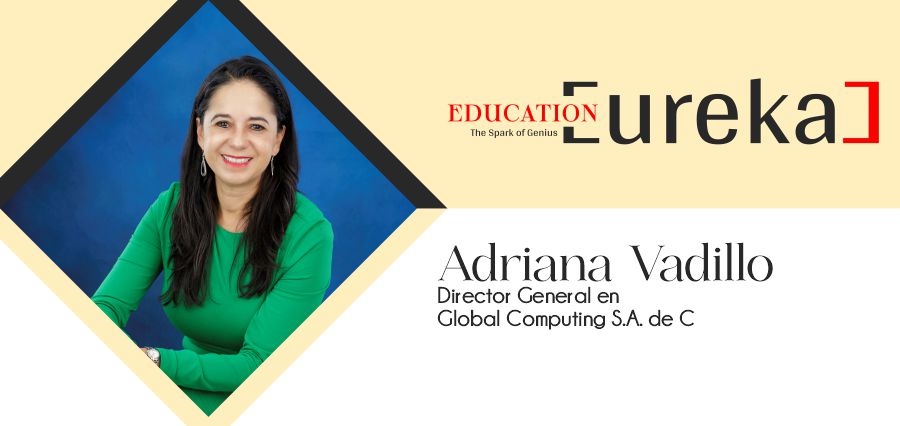
Bringing advanced software to scientists and students across Mexico!
Every semester, students and professors across Mexico sit and wait for funding approvals while their research remains idle. A professor stares at a screen that freezes during a simulation. A graduate student spends a week calculating what modern software could complete in minutes. The time that should serve discovery is consumed by delay.
Talent exists. Curiosity exists. The hunger for innovation exists. The missing link is access.
Many feel frustrated but accept it as reality. Whereas Adriana Vadillo decided to confront it. She saw a blind spot in the academic world. She understood that technology creates opportunity. She asked herself how far Mexico could advance if professors and students had the tools required to run experiments at the pace of global innovation.
That question set her on a demanding path that required resilience, sacrifice, and an unrelenting belief that change was possible.
Adriana remembers feeling motivated by the IT industry because it demanded constant learning, fast movement, and adaptability. The idea of facing new problems each day energized her. Technology changes at a rapid rhythm, and people who succeed inside it embrace that pace.
She explains that the industry pushed individuals to solve problems in real time, evolve skills, and stay alert to innovation. Her curiosity aligned perfectly with those expectations. She wanted a career that offered fresh tests and meaningful impact. She welcomed complexity instead of fearing it.
This drive toward challenge would later define her leadership as she navigated unfamiliar systems and cultural transitions.
When leaders bring foreign companies into Mexico, they confront cultural mindsets, public sector systems, and procurement processes that work differently than in more developed markets. Adriana’s journey began in this terrain as she responded to a need she observed in academia and research institutions.
Adriana was inspired to lead a foreign subsidiary company in Mexico because she wanted to bring leading technologies closer to the academic sector and research institutions that needed to become more productive and efficient in their daily tasks.
She faced significant challenges while leading a foreign subsidiary in Mexico, particularly in navigating the cultural shift toward new technologies and the complex bureaucracy of public sector procurement and funding.
The biggest cultural adjustments were changing mentalities and educating people regarding the use and adoption of new visual data analysis tools additionally to operational adjustments in terms of developing and running a business in Mexico, which is totally different from running and operating a business in first world countries like the United States.
The funding of research projects in Mexico implies lengthy processes in terms of presenting the projects and complying with the requirements of centralized technology agencies from the government that operate in a very bureaucratic and inefficient way to receive funding to develop these projects.
The purchasing procedures of technology from government institutions in Mexico require companies to go through bidding processes to ensure the best price to the end customers. Basically, the end user will tell you what price they want to pay and request so many warrants and legal requirements to be met, and sometimes they end up sending the small and medium businesses to bankruptcy because, in addition to all the requirements, the small and medium businesses have to finance the government institutions by providing credit from 30 to 90 days.
Several key difficulties were present for her:
Cultural and Educational Adjustments
The core challenges were less about the technology itself and more about changing mentalities regarding its adoption.
Bridging the gap between established academic practices and the efficient, data-driven methods common in first-world countries required a substantial educational effort, like:
Navigating Mexican Bureaucracy and Procurement
Her experience with operational adjustments points to a drastically different business landscape compared to countries like the United States.
The procurement and funding processes present substantial hurdles involving:
All these challenges demanded significant resilience and strategic planning to bridge technological gaps while managing the unique operational and financial realities of doing business in a highly bureaucratic market. That experience shaped her approach when she moved from managing subsidiaries to running her own company.
The shift from subsidiary management to leading her own technology firm might appear to require a change in philosophy. Yet her approach remained consistent because her responsibilities had already prepared her.
It did not require any change basically because when managing the subsidiary office, Adriana was involved in the whole operation of the company, including sales, marketing, providing technical support and training to the customers, accounting, etc. And when she transitioned to run her own technology company, she continued to involve herself in the whole operation.
Her leadership continuity was formed following strategic decisions.
Mexico’s academic community had limited access to advanced software and often lacked national intellectual property. Adriana treated this as an opportunity to fill a critical gap.
Some of the most important factors she considered to establish her own company was the fact that for most professors and scientists in Mexico, it was almost impossible to access technology, as there is almost non-intellectual property registered or developed into national products to be offered locally. It was imperative to establish a company that was willing to import software products (at that time distributed in media like tapes, CDs, and DVDs) and make them available in our market in local currency as well.
At the same time, purchase the products in advance from the software manufacturers abroad, import them and deliver them locally, accompanied by other services like technical support and training to help customers protect their investment.
This reliance on mission and access would shape her commercial model.
Technology distribution required financial sustainability, yet Adriana prioritized educational value.
Although a company must be profitable, its mission is to serve and help the greatest number of scientists, professors, and students. Her interest is to have a positive impact and social purpose in her region, and that is why the effort is huge, as the profit margin is only 3 percent. Her company is interested in bridging the gap between the academic and industry sectors.
To serve that purpose, she has worked directly in the field for more than 20 years in the most important public and private universities in Mexico to develop unlimited site licenses so that volume licensing helps reduce prices of the software products and be more accessible to all, and at the same time helps fight against software piracy.
The impact of that effort can be seen through concrete examples.
The adoption of Mathematica in Mexico illustrates how sustained effort and mission alignment enable technological transformation.
An example of collaboration and the impact her company has had in the academic sector of Mexico is the positioning of an algebraic and symbolic calculation software product called Mathematica in almost all private and public universities in Mexico. For this work, she was awarded a social impact grant to study her MBA in Hult International Business School and Cornell University.
Representing international brands required confronting elevated expectations and difficult market conditions.
When foreign manufacturers set sales targets for markets they do not understand, the pressure can be intense. Some of the challenges she encountered are basically to reach the high sale targets set by the brands in a market that they do not know which represents a very hostile market due to lots of competitors most of them not playing by the rules, the purchasing procedures set by the government institutions promote companies to rip each other to get a purchase order instead of promoting the best practices and services.
The software manufacturers set high sales targets and demand fast results in a market unknown to them, which basically implies for her team to do miracles on a very individual basis instead of working collaboratively.
She must be very disciplined, focused, committed, passionate, and self-motivated to get results, always with high standards involving ethics and integrity. Swimming against the current. As she states, we do not tend to get projects offering discounts or by bending the system, but totally opposite from what the market demands: we add value, and in the 27 years she has been running Global Computing, they have never failed in exceeding customer expectations. Her firm has become a guarantee and has become a strategic supplier for key government projects in Mexico.
Those government partnerships required building internal expertise capable of supporting technical needs across sectors.
To serve a broad customer base, the company developed multidisciplinary competencies.
In every way, they had to develop local talent and certified it to be able to provide technical support, training, and consulting services in different types of applications from simulation, risk analysis, quality control, optimization to high-performance computing in a wide range of sectors.
Technical depth alone was not enough; long-lasting relationships required trust.
Her partnerships grew through consistent delivery. She encourages trust and long-term partnerships by always delivering what is expected and exceeding expectations. By always fulfilling what is promised. By respecting customers. By becoming a helping hand and not deceiving them in any way.
These relationships enabled education at scale inside institutions.
Her strategy focuses on empowerment rather than dependency.
The most effective strategies she has found have been training the trainer and making knowledge accessible to all by transferring knowledge within organizations and empowering experts. Certifying people to make them better off, professionally speaking.
This widespread adoption created measurable social impact.
Long-term metrics in education reflect consistent access and funding. She measures impact by the positioning of an algebraic and symbolic calculation product in almost every university in Mexico, which took years of work directly in the field. This software product, called Mathematica, has been used as an essential tool within the Engineering Faculties of almost all universities in Mexico.
To guarantee the continued use of this product for more than 20 years, the institutions have secured funding, and they have even expressed: Maybe there is no money for cleaning supplies, but the money for Mathematica is guaranteed.
In doing so, she had not only to make professors, students, and researchers aware of the product and its benefits within its use in the classroom, but she had to certify and train a lot of people in the academic sector to be able to use it.
Motivation for this work comes from a personal commitment.
Adriana’s purpose is grounded in national development and human potential. Personally, it motivates her to help her country be better off, technologically speaking, and see professors and researchers be more satisfied and happier when they have tools at the reach of their hands to develop their work and be more productive and efficient.
That motivation shapes her view of the coming decade.
She connects the lessons of the pandemic with priorities for future infrastructure. She anticipates innovations around the use of the cloud, and regulations in terms of AI will form the next decade. Specifically, in a time in which society has gone through a worldwide pandemic, it is critical to move to the cloud as the supply chains and physical infrastructures have been affected. Moving to the cloud in a time in which resources are limited will be a viable option for customers in their continued efforts related to High Performance Computing to gain accelerated business performance through increasing efficiency and reducing costs.
In terms of AI, regulations are needed to harness AI as a force for good, a driver of improved well-being for people and the planet. Only through decisive actions and cooperation can society shape a future where AI drives development so that it leaves no one behind.
Across every chapter of her journey, the through line remains constant: perseverance through bureaucracy, commitment to ethics, educational access, and long-term technological advancement for Mexico.
Read More: 8 Smart Licensing Models That Make Advanced Software Affordable for Campuses




Welcome to the future of digital storytelling, where creativity meets innovation. We’re not just a magazine platform; we’re a team of passionate visionaries committed to transforming how stories are shared, celebrated, and experienced in the digital age. Join us as we inspire, inform, and redefine the world of digital magazines.
© Copyright 2025 | educationeureka | All Rights Reserved.