
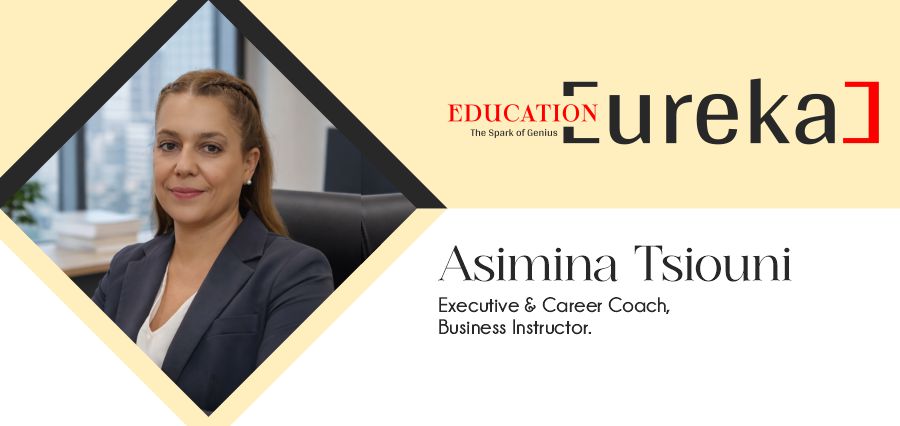
Every organisation invests in strategy, systems, and performance metrics, yet results always come down to people making decisions, building trust, and working with purpose. When energy drops and alignment fades, even the strongest plans lose strength. Asimina Tsiouni built her career around solving this human side of performance through Human Resources leadership and coaching.
She brings more than 25 years of experience across multinational organisations, learning ecosystems, technology transformation projects, and consulting environments. Across these roles she kept one steady belief. People drive every real outcome inside a company. Plans, tools, and data support progress, yet human clarity and connection create movement.
Early in her professional path, she felt drawn to human interaction. She studied how people communicate, how teams respond to pressure, and how workplace systems influence behaviour. She observed a pattern across organisations. Many frameworks focused on efficiency and structure, while very few addressed meaning, motivation, and emotional alignment. That gap formed her direction.
Her work gradually moved closer to development at an individual level. She chose to work inside conversations, leadership journeys, and mindset shifts. Coaching became a natural extension of her Human Resources foundation. Through coaching, she helps professionals reconnect with purpose, strengthen self awareness, and make grounded decisions.
The arrival of artificial intelligence and automation increased the importance of her focus. Digital tools accelerate output and analysis, yet values, judgement, and ethical direction still come from people. She sees today’s workplace as a space where technology grows fast while human grounding requires deliberate care.
Her approach connects systems structure with human depth. She supports organisations through change while also supporting individuals through inner reflection and direction finding. Leaders who work with her often gain clearer communication habits, stronger relational awareness, and steadier judgement under pressure.
For Asimina, coaching serves as a compass process. It helps professionals and organisations rediscover direction, strengthen connection, and act with intention. When people gain inner clarity, performance follows with greater consistency and meaning.
Where Change Leadership Began
Working across human capital, coaching, learning, digital transformation, and project management exposed her to repeated patterns inside organizations. Over time, Asimina observed that performance issues often had less to do with skill and more to do with environment and leadership behavior. She frames the origin of her focus on organizational change through what she witnessed in real workplaces:
There wasn’t just one moment, there were many small awakenings. But the turning point was always the same pattern: She kept seeing extraordinary talent shrinking, disengaging, or underperforming, not due to skill gaps, but because the culture crushed their curiosity, and leadership communication either missed the mark or was absent entirely. People weren’t lost because they couldn’t do the work; they were lost because they couldn’t see the meaning in it.
Every human being wants to feel part of something bigger than themselves. People want to belong, to be appreciated, to be aligned with a mission that feels authentic rather than manufactured. Leaders who understand this create a different kind of impact. They don’t simply manage tasks or KPIs; they connect with people. Coaching became one of the most powerful tools to help leaders recognize the invisible walls they had unconsciously built, and then begin to dismantle them.
Awareness changes presence, and presence changes systems. Much like in physics, where observation alters reality, leadership presence reshapes behavior, trust, and performance. When leaders become aware of the influence they carry simply by how they show up, team coaching often becomes the catalyst that restores inclusion, trust, and shared resolve.
Bridging People, Processes, and Technology
In large-scale global transformation projects, gaps between people, processes, and technology often derail outcomes. Asimina approaches these elements as interdependent parts of one system rather than separate tracks:
People, processes, and technology are not separate forces competing for attention, they are pieces of a single living system. The challenge is finding the rhythm between them. Without shared purpose and meaningful communication, technology becomes a clamoring distraction and processes become a cage.
But when people understand the reason behind the change, when processes support rather than dictate, and when technology amplifies intention rather than replacing heart, that is when sustainable results happen.
When describing how she personally bridged those gaps, she presents it directly: through authenticity and truth. Communicating with clarity, respect, and real adaptation to the audience and the moment.
As Aristotle wisely observed, “Everyone can speak, that is easy, but to communicate with the right person, to the right degree, at the right time, for the right purpose, and in the right way, that is not within everybody’s power and is not easy.”
Cultural Barriers Leaders Still Face
In organizational culture, change, and digital transformation consulting, Asimina repeatedly encounters structural and behavioral barriers that slow real progress. She identifies the obstacles in direct terms:
The most persistent barriers are silos, communication breakdowns, fear of vulnerability and leadership detachment. Top executives often feel isolated from the day-to-day realities of their teams. Middle managers sometimes present a softened version of reality to survive upwards. Power plays and politics replace purpose.
Organizations tell her they want innovation, but their culture punishes vulnerability. They want agility, but their processes reward certainty. They want quick results, when direction is unclear, complex and ambiguous. Culture doesn’t shift because of slogans or values and credos hang on the walls; it shifts through daily leadership behaviors that honor truth, invite dialogue, and make space for feedback.
She helps leaders dismantle silos by encouraging curiosity over conviction, dialogue over directives, and shared understanding over unilateral decisions. Healing culture starts with leaders who are willing to reflect first, then act.
The Coaching Method That Unlocks Leaders
In executive and career coaching, techniques often become overcomplicated. Asimina’s core method stays grounded and direct:
The most powerful technique she uses is deceptively simple: active listening with genuine empathy and presence taking under consideration the system frame. It is not about just hearing words, but sensing what is not being said. Often the answers are already inside people, but they lack the space to access them.
Coaching, in her model, is about creating the conditions where leaders can hear themselves think, where their assumptions get challenged gently but honestly, and where they can see the patterns that limit them and understand the ripple effects of their decisions: on teams, peers, customers and the wider ecosystem.
When leaders connect with their inner compass and understand the invisible cost at all levels their impact multiplies.
Learning Through Teaching Adults
Years of teaching HR strategy, leadership, change, coaching, and wellness at university level reformed how she approaches development and learning itself. Asimina treats instruction as a two-way discipline:
Being a teacher makes her a perpetual student. Only when someone stands in front of a room trying to articulate a concept does the depth beyond the textbook become visible. As Socrates said, “I know one thing, that I know nothing.” Teaching reinforced this truth for her.
Each student brings a unique lens, and each interaction unveils new perspectives and even contradictions that make learning richer. Because teaching is not talking to an audience, it is about interaction, relevance, sharing and involvement.
Asimina holds that lifelong learning is not a slogan, it is a way of living. Growth happens when leaders feel safe enough to question their own beliefs, open enough to hear dissenting views, and humble enough to change.
Creating that space supports wellness, belonging, productivity, creativity, and innovation. Leaders who cling to old models of authority often end up isolated. To go far, you go together.
Psychology Inside Digital Transformation
In digital-first settings, change efforts often fail because leaders treat transformation as purely technical. With her MSc in Strategic HR Management and Psychology, Asimina grounds change work in human behavior and motivation first, then systems and tools.
Psychology, in her framework, is the substrate below all organizational and individual behavior. It shapes how people respond to change, what motivates them, how they form trust, how they protect themselves psychologically, and how they make meaning.
The same fundamental human needs Maslow described, safety, belonging, esteem, self-actualization, still operate, even in highly digital environments. She observes that leaders often forget this truth when transformation becomes tool driven.
Asimina integrates organizational psychology by helping leaders recognize emotional responses as data, not obstacles; by understanding cognitive load as a real constraint; and by designing interventions that respect both individuality and collective dynamics.
In essence, digital transformation and change succeeds when individuals are invited to co-create change, then momentum naturally follows. The system moves because humans move, not the other way around. That is why successful digital transformation is human transformation first.
Credentials Versus Real Practice
Asimina’s background includes Evidence-Based Coaching, Counseling & Career Mentoring, Project Management, Emotional Intelligence, Philosophy, and Adult Training. Instead of presenting credentials as authority alone, she separates formal knowledge from applied judgment.
Those qualifications gave her knowledge structure, ethics, and methodological rigor, but the classroom of practice taught her wisdom. Knowledge alone is inert without context. If someone possesses expertise but lacks ethical grounding, frame or human connection, it will not be effective. The key lesson she applies daily in consulting is direct: balance the frame and the human in front of you.
Structure is valuable, but rigidity kills insight. No framework should feel like a cage. The art of consulting is knowing when to use the frame, and when to let it breathe.
The Message Audiences Remember
Through her work as an author, podcast voice, and motivational speaker across HR, coaching, wellness, and psychology, certain themes consistently land with audiences because they challenge normalized burnout culture.
The most resonant message she brings forward is this: success without well-being is not success. Audiences respond when they hear that ambition and humanity are not opposing forces. Too often, people were taught that stress equals effort and burnout equals commitment. She rejects that logic directly. Humans do not thrive in machines; they thrive in meaning.
When people understand they can pursue excellence and preserve dignity and well-being at the same time, something shifts in how they work and decide. In Asimina’s view, the reaction is strong because the need comes from within and people can no longer tolerate acting against their own rhythm and nature.
The Role of Professional Communities
Active participation in professional bodies such as EMCC, SDADE, PMP, and Lean in HR Leaders shaped how she views resilient leadership and inclusive cultures. She treats networks as working laboratories, not status markers.
Asimina often anchors this belief in a simple line: “If you want to go fast, go alone. If you want to go far, build community.” Being part of value aligned professional networks expands perspective, challenges assumptions, and connects her with practitioners whose experiences add range and correction. Leadership today is not a solo act. It is collective intelligence and shared accountability.
Exposure to diverse peer groups keeps reforming how she interprets resilience and inclusion, not as checkboxes, but as lived practices.
Advice to Emerging Human Capital Leaders
Looking back at her BSc in Business Administration and long career across transformation and human capital, her guidance to newer professionals is practical and unsentimental.
Degrees and certifications give vocabulary and frameworks, but they are not what makes the difference. What matters most is engagement, curiosity, integrity, and impact. Asimina encourages professionals to love what they do, think beyond job descriptions, and ask how their work changes people’s lives. Think big but walk small, consistent action, one step at a time. Trust the process.
When values, rhythm, and vision align, outcomes often exceed expectations, often with less force than when everything is pushed. Learn the business but also study the people and the systems. Build technical expertise but also cultivate self-awareness. And never confuse speed or typical achievements with progress.
The Future of Work and Human Systems
From her cross functional lens across culture, psychology, and digital change, she reads the future of work as already visible in early signals rather than distant forecasts.
Generational shifts, new expectations, global disruptions, and digital and cultural transformations have already rewritten the rules. The future belongs to flexibility, resilience, creativity, lifelong learning mindset, trust and real meaning, not rigid structures or command and control hierarchies.
Flat, agile organizations with clear purpose, psychological safety, and respect for diversity will lead. Diversity, in her definition, must go beyond gender or race; it must include personality, rhythm, cognitive style, and ways of thinking.
She is direct about burnout: it does not come from hard work; it comes from narrow systems that reject alternative voices. When organizations make space for human rhythms and differences, they unlock not only performance, but depth and commitment. In her outlook, technology will be a human ally, not an adversary. Collaboration will be more open, idea sharing less fearful, and purpose more visible. Leadership will be measured less by power and more by human flourishing.
Asimina closes that future view with a classical anchor she keeps unchanged: Gnōthi seauton (Know Thyself). Mēden agan (Nothing in excess).