
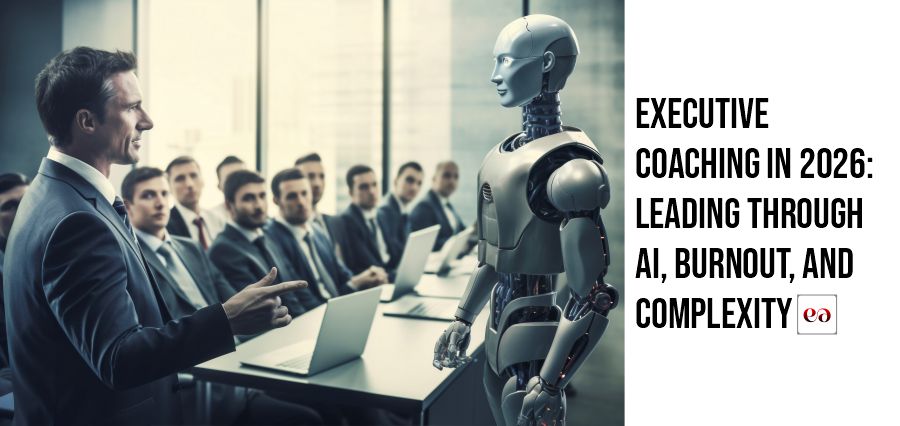
Leadership used to be difficult because markets changed slowly. In 2026, difficulty comes from speed. Artificial intelligence is rewriting workflows overnight. Teams work across time zones without meeting physically. Employees are mentally exhausted while still appearing productive. Decision cycles that once took months now compress into weeks or sometimes hours.
Executive coaching has quietly moved from being a prestige benefit for CEOs to a strategic survival tool for organizations navigating uncertainty. Companies are investing heavily because leadership itself is under strain. Research shows 71% of leaders report increased stress and nearly 40% are considering leaving their roles, highlighting a growing leadership stability crisis.
The coaching conversation in 2026 is no longer about charisma or presentation skills. It is about helping leaders think clearly when complexity refuses to slow down.
Why Executive Coaching is Expanding Rapidly
Executive coaching is no longer niche. The global executive coaching and leadership development market is projected to reach over USD 112 billion in 2026, driven by AI transformation, succession gaps, and faster strategic cycles.
Several forces explain this growth.
1. AI Has Changed Leadership Expectations
Executives are expected to understand artificial intelligence deeply enough to guide strategy, ethics, hiring, and risk decisions.
AI now acts as a decision partner in many organizations. Some executives even trust algorithmic insights heavily during strategic planning. Yet AI also introduces ethical uncertainty, data risks, and workforce anxiety.
Coaches increasingly help leaders answer questions such as:
- When should AI guide decisions versus human judgment?
- How do leaders maintain accountability when algorithms influence outcomes?
- How can executives communicate AI adoption without triggering fear among employees?
Studies show AI adoption increases job stress and health pressure when poorly managed, while coaching leadership can reduce these negative effects.
In other words, AI creates efficiency. Coaching helps leaders stay human while using it.
Burnout is No Longer Personal. It is Structural
Burnout used to be framed as an individual failure to manage stress.
That explanation feels outdated today.
Economic uncertainty, automation anxiety, hybrid work fragmentation, and constant performance tracking have created what many experts describe as structural burnout. Employees often continue showing up physically or digitally while mentally exhausted.
Recent reporting from Bengaluru workplaces shows rising “presenteeism,” where employees work despite anxiety or emotional exhaustion because of job insecurity tied to AI disruption.
Leaders experience this pressure first.
Executive coaching sessions increasingly focus on:
- Emotional regulation.
- Decision fatigue.
- Boundary setting in always-online environments.
- Navigating difficult conversations during layoffs or restructuring.
Global coaching surveys show burnout and overwhelm account for over 12% of coaching focus areas, while navigating ambiguity remains the top leadership challenge.
The implication is clear. Organizations are no longer asking coaches to motivate leaders. They are asking them to stabilize them.
AI Coaching Tools Are Rising, But Human Coaches Are Not Disappearing
One of the biggest questions executives ask today is simple.
If AI can coach, why hire humans?
AI-powered coaching platforms already provide continuous feedback, goal tracking, and simulated conversations. Organizations using AI-assisted coaching report improvements in engagement and leadership effectiveness because support becomes available anytime rather than only during scheduled sessions.
However, research shows generative AI works best as augmentation rather than replacement.
AI handles:
- Behavioral pattern analysis.
- Feedback reminders.
- Learning recommendations.
- Scenario simulations.
Human coaches remain essential for:
- Emotional nuance.
- Ethical dilemmas.
- Identity transitions during promotions or failures.
- High-stakes decision reflection.
Leadership increasingly happens at psychological depth rather than technical skill level. Algorithms struggle to interpret ambiguity shaped by culture, ego, and personal history.
Executives often want someone who can challenge assumptions safely. That role still belongs to humans.
Complexity is Now the Core Leadership Skill
The most common coaching topic globally is navigating uncertainty.
That may sound abstract, but the daily reality is concrete.
A senior leader might simultaneously manage:
- AI implementation pressure from investors.
- Talent shortages.
- Remote team disengagement.
- ESG expectations.
- Rapid geopolitical market changes.
Traditional leadership training taught frameworks.
Coaching now teaches thinking.
Modern executive coaching focuses heavily on:
- Systems thinking.
- Stakeholder mapping.
- Adaptive communication.
- Scenario planning.
Organizations increasingly recognize that technical expertise alone does not prepare leaders for complex environments.
Gallup research shows declining manager engagement significantly reduces workforce engagement worldwide, creating massive economic impact.
When managers struggle mentally, organizations struggle culturally.
Emotional Intelligence Has Become a Competitive Advantage
Ironically, technology has made emotional intelligence more valuable.
As AI scales efficiency, trust becomes the scarce resource.
Human-centered leadership emphasizing empathy and psychological safety is emerging as one of the defining leadership priorities of 2026.
Employees today worry about automation replacing roles, performance surveillance tools, and unclear career paths.
Coaches help leaders learn:
- How to communicate uncertainty honestly.
- How to rebuild trust after restructuring.
- How to motivate teams without false optimism.
Research consistently links emotional intelligence to stronger team collaboration, ethical leadership, and motivation outcomes.
Executives increasingly realize people do not leave companies because strategy failed. They leave because leadership communication failed.
Coaching is Moving Beyond Individuals
Another shift shaping 2026 is collective coaching.
Organizations are no longer coaching only CEOs.
They are coaching:
- Entire leadership teams.
- First-time managers.
- High-potential AI specialists transitioning into leadership roles.
Digital platforms have lowered cost barriers, allowing SMEs to access coaching previously limited to multinational corporations.
Team coaching focuses on shared decision making, cross-functional alignment, and conflict resolution across hybrid environments.
This reflects a deeper understanding.
Leadership failure rarely belongs to one person. It usually belongs to systems.
Ethical Leadership and AI Literacy are Emerging Coaching Themes
AI literacy is becoming a core executive competency.
Leaders must understand:
- Bias in algorithmic decision systems.
- Data privacy implications.
- Responsible automation practices.
Executives adopting AI faster than employees has already created workplace tension in some organizations, reinforcing the need for inclusive transformation strategies.
Coaches increasingly act as interpreters between technical teams and business leadership.
They help executives slow down long enough to ask better questions.
What Executive Coaching Looks Like in Practice Today
A typical executive coaching engagement in 2026 may include:
- AI-generated leadership behavior analytics.
- Monthly deep reflection sessions.
- Real-time digital nudges during stressful decisions.
- Scenario simulations for crisis communication.
The goal is not performance optimization alone.
It is clarity.
Executives face constant information overload. Coaching creates structured thinking space.
Many leaders describe coaching sessions as the only hour where they are not required to perform certainty.
The Future of Executive Coaching
Executive coaching is evolving alongside leadership itself.
Three trends are likely to dominate the next phase:
- Hybrid human and AI coaching ecosystems.
- Greater focus on mental resilience and well-being.
- Coaching integrated directly into organizational strategy rather than HR programs.
As AI becomes faster and markets become noisier, leaders will increasingly need places where thinking slows down.
Executive coaching in 2026 is not about fixing weak leaders.
It exists because leadership itself has become one of the most complex roles in modern work.