
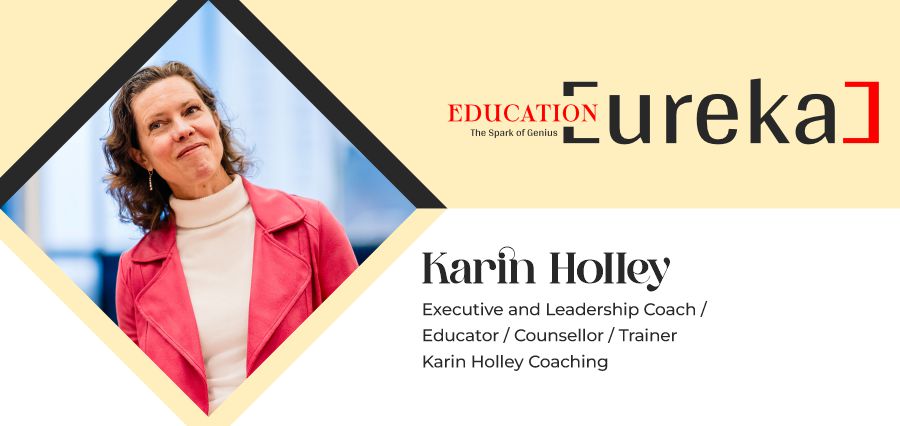
Karin Holley: Finding Growth in Every Step
Coaching, transformation, and living with purpose through intentional action and learning!
We all reach moments in life where we feel stuck, going through the motions without excitement or curiosity. Those moments can be uncomfortable, but they often signal the start of something new. For Karin Holley, recognizing these moments has shaped a career built on helping people grow and discover their potential. For over 25 years, she has worked in the professional and personal development and learning industry, finding purpose in both her own growth and the growth of others.
Karin has always been drawn to action. She discovered that Coaching gives people the tools to move forward, while Traditional Counseling often focuses on advice and reflection. Having experienced therapy and coaching herself, she felt a deep shift through Coaching and the framework she now uses, Positive Intelligence. This approach brought change she had not found in talk therapy, showing her the power of action combined with insight.
Her favorite part of Coaching comes from watching transformation happen in real time. She loves seeing “lightbulbs go off” in people’s minds, watching confidence grow, and witnessing clients achieve things they once thought impossible. Growth excites her, and she acknowledges her own challenges with the same curiosity she encourages in others. Plateaus and major life/career transitions signal moments to push further, to learn deeper, and to explore new possibilities.
Karin focuses on the present and the future in her work. While reflection can bring understanding, true change comes from creating daily practices, making intentional choices, and connecting with one’s purpose. She helps her clients anchor themselves in the reasons behind their actions, keeping them motivated and grounded as they move forward.
For Karin, coaching is a shared journey. Every client brings a story, and the magic lies in helping them write the next chapter. Growth is alive, practical, and human, developed by curiosity, courage, and consistent effort. She continues to learn alongside her clients, showing that development is ongoing and exciting.
Her journey teaches us that progress comes from stepping forward, embracing challenges, and discovering what we are capable of. Growth is a choice made every day, and the joy of learning, evolving, and discovering what is possible is a gift we can give ourselves at any moment.
Let us learn more about her journey:
Growing up overseas, moving schools often, and frequently being the foreign child in the class, Karin learned to listen and observe. She was quite shy and experienced intense loneliness in her life. She did not initially realize this was the reason she went into counseling and coaching. The realization came to her during a coaching and training session, where she looked back at the lessons she had learned and how they had shaped her.
Relatively recently, she realized that she wants other people to feel seen and heard, specifically because she did not experience this for a very long time herself. One of her core values is connection. Achieving a deep connection with others is truly beautiful; it happens through empathy and curiosity, which allows both her and her client to discover who they truly are, underneath all the layers of protection and armor accumulated throughout life. It is a liberating experience that feels like unconditional love.
She is fascinated by humans; they are complex beings, and that is where the curiosity comes in. Curiosity is magic. In a visualization exercise, she realized she is an explorer at heart. She used to explore the outside world, travel, and different cultures, but now she is on an exploration of understanding herself, others, and life in general. Curiosity also brings the quality of non-judgment. Nothing is good or bad; it just is. Humans can also question the truth behind their beliefs by being curious. Curiosity sets people free and helps them acquire knowledge. Ultimately, knowledge of the world and of the self grants freedom from the things that used to limit them.
When asked how her mission to foster love and sustainability has influenced her leadership approach, Karin said:
The two primal emotions are fear and love. When we act from a state of fear and survival, we disconnect, protect, attack, destroy, and defend. This state is isolating, exhausting, and we lose ourselves in the process; we armor up. Fear keeps us stuck.
Even in our modern economy, there is often a fear underlying the compulsion to accumulate more wealth. It can be a fear of not being enough without wealth, or a fear of not being able to take care of oneself or one’s family. This idea that material things and wealth guarantee security has unfortunately, resulted in us destroying our planet. I believe we must take care of our home, for ourselves, for others, and for the other life forms that inhabit the Earth.
Fear also drives us to feel threatened by others. If we want to live in a peaceful world, where there is room for everyone, where people are treated with respect, where we foster connection instead of polarization, and where we care for others and the planet as we would ourselves, then we need to approach people and situations with love.
However, love is sometimes mistaken for “Ms. Nice” or being a pushover, which I disagree with. A loving parent does not constantly give a child everything they want; it means setting boundaries, being kind but firm and clear, and holding both yourself and others accountable. Being “nice” is not the same as “loving.”
In my leadership, and with the clients I attract, we share a common purpose: wanting to make a positive difference in our businesses, institutions, and communities. We need to model sustainability and love for others. To work toward a more sustainable economic and geopolitical model, we must start with ourselves by adopting a lifestyle that is sustainable and loving for us. This means working in ways that do not cause burnout, but instead allow us to show up as the best versions of ourselves as much as possible. We need to take care of ourselves so our impact is optimal and we can contribute to solutions instead of adding to the problems.
Sometimes Karin shares her experiences with clients, but the sharing is not about her; it is done because the story might spark an insight for them. In those moments, her “vulnerability” does not transform her.
What feels vulnerable is being reflective about her coaching practice, realizing when she should have held back, stayed silent, or taken a different approach, and then admitting that “failure” to herself, and sometimes to the client.
She recalls a time at the start of her practice when a client was completely overwhelmed, and no matter what question she asked, the client stayed “stuck” in her overwhelm. They both ended the call feeling deflated. It was a good lesson, and Karin apologized to her for trying to “coach” her. She learned that one cannot coach people when they are in panic or overwhelm mode. At that moment, they simply do not have access to their own wisdom. Therefore, the first step is to allow their thoughts and emotions to be heard, settle, and calm down.
It is like trying to decide which way to go when the road is foggy and one cannot see ahead; that feels very scary. Before moving forward, one must wait, rest, and give oneself time. Then, as the fog lifts (which it will, but cannot be forced), clarity comes.
Leaders often face moments of self-doubt, especially when making critical decisions or stepping into unfamiliar roles. These moments can challenge their sense of authenticity and confidence.
Self-doubt is normal; we all have those moments. The only way to find out if you can or cannot do something is to try. So, as long as the self-doubt does not become paralyzing, we can work with it. A certain amount of doubt keeps us humble and on our toes, preventing us from taking ourselves and others for granted.
Self-doubt is just a thought. It is often based on past experiences and beliefs, but we have the power to choose how we act when we become aware of those thoughts. Every moment, we can choose differently.
In moments of self-doubt, we turn inwards to find what we know to be true. We connect with what is important to us: our values, our purpose, and who we are at our core. This is about knowing yourself deeply, and nobody can take that away from you. This deep self-knowledge is a source of power that acts like an anchor during challenging times and moments of self-doubt. It is also a whole-body connection, not just a cognitive insight.
From this place, confidence grows automatically, step-by-step, by choosing with intention and experimenting with new ways of being. It is beautiful to witness growing confidence and self-belief as people discover they are much stronger and more resilient than they think, and that they can do hard things.
Being the change leaders wish to see means embodying the principles they advocate in every action. Leaders must demonstrate authenticity and consistency.
Leaders cannot preach one thing and do another; they need to walk the talk.
Complex challenges cannot be solved by any single individual. Sustainable and impactful leadership shifts from a top-down approach to one that is inclusive and empowering. Addressing challenges effectively requires collaboration and giving everyone the opportunity to lead in their areas of expertise.
Leadership now involves modeling transparency, vulnerability, and collaboration, while demonstrating the ability to lead without having all the answers. Leaders take on a coach-like role, empowering others to step into leadership themselves.
Change-makers often carry a sense of idealism, believing in the possibility of positive transformation for themselves, their organizations, and the planet. This idealism can clash with the pressures and demands of real-world systems, creating moments of overwhelm or discouragement.
Karin’s idealism stems from the belief that we truly can make a difference and that positive change is possible for ourselves and for the planet. She has to believe this; it fuels her every day. The systems, real-world demands, and pressures can feel overwhelming and depressing.
However, she emphasizes focusing on what is within our power to change, which means focusing on one conversation, one step at a time. We choose to focus on what is working and focus on seeing the good. This takes a lot of work and intentionality because our brains automatically go to ‘survival mode’ and notice all the problems and everything that is not working.
Clients learn how to ground and center themselves amidst the chaos. Ultimately, the goal is for them to recover quickly from setbacks and focus on what is truly important.
When a client feels stuck despite external success, discovering purpose is about connecting with their core, with what is truly important to them. Since this can change over time, it is important to revisit it periodically. This is especially true when clients feel they are on “automatic pilot,” just going through the motions, or feeling like they are on a hamster wheel, running hard without being sure why they are doing it.
The purpose is connecting with what gives them meaning in their life. It is often deeply connected to their values and strengths. The process involves a combination of knowing your purpose cognitively, but also connecting to it deeply, emotionally, and feeling where it sits in your body.
Understanding oneself fully requires more than thinking or analyzing; it involves connecting with the body and the sensations that carry past experiences. Karin explains that somatic coaching involves seeing the client as a whole human being with a mind, body, nervous system, feelings, sensations, ego, thoughts, habits, beliefs, actions, and non-actions. We can’t rationalize our way out of situations. If we could, probably fewer of us would feel stuck or need coaching.
All of us develop coping mechanisms to deal with challenges and trauma in our lives to keep us safe. These mechanisms are automatic and ingrained deep within our entire nervous system, not just the brain. As a result, our bodies take on certain shapes, such as a clenched jaw, a frown, tight shoulders, a hunched back, or superficial breathing.
Therefore, we need to work with the body to make lasting changes. We need to feel and sense the old habitual patterns so that we can recognize when they show up. This awareness then gives us more room to try a different reaction and take on a new, intentional “shape.”
We learn ways to find safety in our bodies to allow strong and uncomfortable emotions to be present without avoiding or ignoring them. Many people spend years avoiding these emotions, but they always resurface in other ways, often as behaviors that do not serve us, such as addictions or numbing/dissociation.
Many people struggle to experience true joy and fulfillment because certain internal mindsets and beliefs shape how they perceive life. Karin identifies several of these common barriers:
These beliefs accumulate to keep people safe from harm, but they limit potential, success, and happiness.
A coach’s background can deeply influence the way they guide others. Karin’s dual experience in counseling and education forms the foundation of her distinctive coaching style, allowing her to combine teaching with emotional support in a meaningful way.
Many of Karin’s clients are senior leaders with busy jobs. Their stress levels can be high, leading them to react in ways they later regret.
Breakthrough moments can happen during coaching sessions, but also when clients are practicing the skills they learn and making intentional choices based on their insights.
On a personal level, this can look like a moment of deep gratitude for reading a bedtime story to their child instead of rushing them to bed to get back to their laptop and do more work. Or it could be letting go of perfectionism to lead a more balanced life, and adopting an exercise or morning routine to start the day with more energy and positivity.
Professionally, breakthroughs can look like staying calm in a crisis, feeling confident going into difficult conversations, shifting the culture of entire teams to one that is more inclusive, positive, and impactful, or stopping the avoidance of making hard decisions, such as firing someone or putting them on a performance plan.
Karin believes she achieves this through her presence. Presence is an ephemeral term, yet people can sense it. Cultivating a coaching presence means bringing a certain energy and quality, a state of being, to the conversation that embodies deep empathy, curiosity, non-judgment, and authenticity. She truly embodies these qualities, being genuinely curious rather than merely knowing she should be.
She meditates to maintain a quality of calm, groundedness, and safety, and to remain aware of triggers from what clients share. Her goal is to serve as an anchor when clients are unsure where to find their own, while staying conscious of her own reactions to remain grounded in the moment.
Karin works on this presence daily by taking good care of herself. She engages in practices that keep her energy high yet calm, including a mostly vegan diet, daily exercise, mindfulness and meditation, walks in nature, and limiting stimulants such as sugar, coffee, and alcohol. These routines act as fuel for her mind, body, and soul, keeping her fresh and ready for each conversation.
Taking leaders through the Positive Intelligence training proves incredibly powerful and transformative. To increase her impact, she has begun guiding entire teams through the program to develop high-performing teams by enhancing their emotional intelligence, resilience, and energy levels.
This approach also fosters cultures of belonging where individuals can show up authentically, thereby increasing their overall impact. Her background in education equips her exceptionally well to provide coaching and training to educational leaders and within school settings.
Read Also – Anne Gélébart. A multilingual ICF-certified coach and leadership trainer,


Welcome to the future of digital storytelling, where creativity meets innovation. We’re not just a magazine platform; we’re a team of passionate visionaries committed to transforming how stories are shared, celebrated, and experienced in the digital age. Join us as we inspire, inform, and redefine the world of digital magazines.
© Copyright 2025 | educationeureka | All Rights Reserved.