
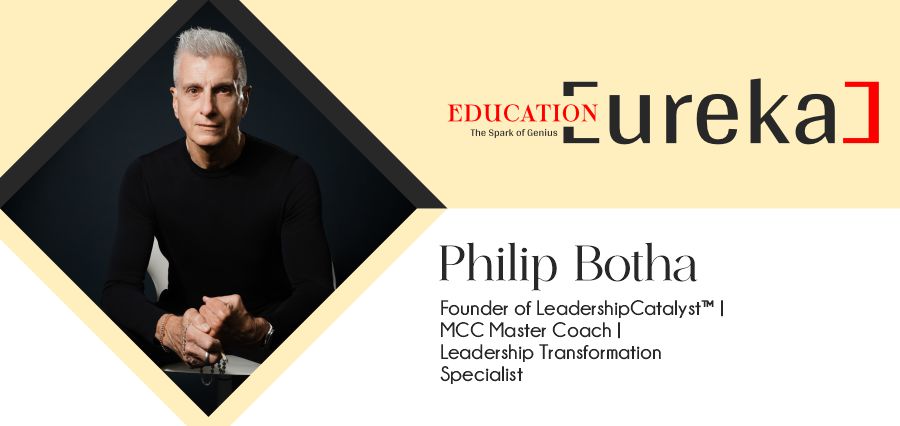
A master coach who brings mental, emotional, energetic, and archetypal insight into the way leaders grow!
People in leadership and business often rely on momentum. When a plan works, it gives a sense of security. When it collapses, everything feels uncertain. Philip Botha knows this feeling with deep honesty. His early career moved through senior marketing roles with steady progress until he reached the Vice President of International Marketing at Universal Music International in London. The pace, the responsibility, and the thrill of global work filled his life. Then the dot-com bubble burst. His job disappeared overnight, and with it went the identity he believed was solid. He pushed harder, tried to recover the life he had built, but every attempt stalled. After a long struggle, he came to accept that life was shifting in a direction he had never imagined.
During this intense period, a simple yoga class provided a welcome break from the pressure. Ten minutes into a breathing practice, something quiet rose within him. It felt steady and clear. The message was simple. He needed to become a yoga teacher. This moment of revelation he could not ignore. Two years later, another moment just as clear arrived. It pointed him toward coaching, a path he later formalised through rigorous training. He qualified as a Certified Professional Co-Active Coach (CPCC) through The Coaches Training Institute and went on to earn the Master Certified Coach (MCC) credential from the International Coaching Federation.
Philip later devoted himself to his own inner work early on, exploring meditation, retreats as a participant, value-based reflection, emotional inquiry, and energy-based practices. Later, as a coach and leadership facilitator, he led more than 150 Authentic Leadership retreats and delivered over 450 workshops alongside 4500 coaching hours. His personal practice evolved into a process he applied in the retreats he led, which eventually formed the inner model that underpins LeadershipCatalyst.
Through this deep experience, a structure slowly appeared in his understanding of growth. He named it Explore → Transcend → Transform™. It is not strictly linear. It works as a developmental cycle that continues to deepen over time. It imitates the way a person looks inward, rises above patterns that limit them, and moves into a life aligned with their deeper truth.
LeadershipCatalyst™ grew from everything he lived through. Philip designed it to guide leaders from fate to destiny by working across mental, emotional, energetic, and archetypal layers of self. He encourages leaders to approach their work from inner coherence, where personal truth informs outer influence. His goal is simple. When leaders connect with the core of who they are, transformation becomes real.
After years of guiding others, one principle stands at the center of Philip’s approach. The magic starts with connection. His life followed this principle long before he formalized it, and every leader who walks into his sessions experiences that same steady, human truth.
Let us learn more about his journey:
When Authenticity Revealed Its Deeper Architecture
In his early coaching years, Philip often felt he was tracking something real but not yet nameable. He watched leaders grow in ways that did not fit the simple definitions he had been taught. During one retreat, he noticed that the shifts he kept witnessing were pointing to a deeper inner architecture he had not mapped yet, and that realisation set the stage for a long period of inquiry.
Philip later explained that the original definition of authenticity he learned was simple. Live in alignment with your values. It helped, but it did not describe how alignment deepens or why it changes a person from the inside out. His own experience kept showing him that something more was going on. Over years of coaching and running Authentic Leadership retreats, he saw that alignment lives at different depths. Cognitive, emotional, and eventually, as an inner field of coherence.
The breakthrough arrived when he encountered a brain dominance profile. It revealed patterns of thinking, reacting, and protecting. What he now calls biological authenticity. Seeing it laid out so clearly helped him understand something he had heard many times. But I am who I am.
That moment pulled the entire journey into focus for him. Leaders were moving from biological authenticity toward values-based authenticity, and eventually into soul-aligned expressions of self. What he had sensed for years finally formed a structure he could name. The Architecture of Authenticity™. It captured the evolution from automatic identity to consciously aligned being. And he kept seeing one thing. Leaders only understood it once they lived it. Once that inner connection landed, they stepped into a coherence that changed how they spoke, decided, and showed up.
Seeing the Patterns Leaders Miss
Before Philip ever taught leaders to recognise their blind spots, he spent years noticing his own. Meditation, coaching, and intense self-study taught him that real transformation hides in the pauses, the hesitations, the subtle shifts most people overlook. That sensitivity trained his eyes to read patterns others could not yet see.
Philip notes that his ability to see and identify patterns came from exploring himself as intensely as he observed others. Every development journey is the result of becoming conscious of our own triggers, beliefs, and protective behaviours. Through his years of meditation, coaching, and retreats, he became aware of how patterns often reveal themselves not through content, but through tone, expression, sense, or even hesitation.
One moment in particular stayed with him. During a guided visualisation with a senior leader, an archetypal form appeared in duality. One shadow, one light. Archetypes in this context are inner energetic structures or constellations that show themselves symbolically and help express and process dynamics that sit below conscious awareness and shape how we feel, behave, and relate. They looked separate at first but revealed themselves as two expressions of the same underlying energy.
As the process unfolded, the shadow softened and dissolved into the lighter expression. Integrated, balanced, whole. What happened next echoed a pattern I have seen many times. Once the duality was explored and brought into awareness, the imbalance resolved through the structured process, and the two expressions returned to integration. The shift that followed ran deeper than any cognitive insight could reach.
To Philip, patterns are symbolic expressions of an inner architecture. Once they become visible, they change everything. When leaders feel safe enough to explore that terrain, they start working with what held them back and begin building what moves them forward. Transformation becomes the natural result.
Breaking the Authenticity Myth
As Philip worked with more leaders, he kept hearing the same line. I am who I am. It always came from the same place. Not confidence, but protection. Watching this pattern repeat made him question the entire idea of authenticity as a personality trait. That curiosity opened a new chapter in his work.
For him, authenticity was a state of deep inner alignment with values and what matters most. An awareness that expands in depth every time we reflect.
He saw this unfold again and again during retreats. Values did not behave like concepts. They moved like clusters of meaning that shaped a person from the inside. Once explored deeply enough, they produced a coherence that people could physically sense. The shift was energetic. It motivated. It changed behaviour from the inside out.
When awareness shifts, people shift. Their inner coherence naturally expresses itself as a leadership impact. This is why he never begins with theory. Leaders grasp authenticity only when they feel their inner field shift and then see their world respond differently. In that moment, authenticity stops being a protective trait and becomes a way of being. And when leaders operate from that alignment, everything sharpens. Conversations, decisions, pressure, and team dynamics. The change is unmistakable.
When Values Hit Real Life
Across thousands of sessions, Philip noticed something that kept repeating. When people touched what truly mattered, their entire presence changed. Their breath shifted. Their posture softened. Something inside them opened. That consistent reaction made him realise that values were not ideas. They were active forces working through the body and the psyche. He wanted to understand how.
Philip recalls that from the very beginning of his coaching, he realised he could not work without values. When people connect to what truly matters, there is a noticeable shift in energy. You can feel it in their presence and often see it in physical reactions. In his experience, values are not ideas. They are energetic sources that can activate the parasympathetic system and shift behaviour when engaged consciously.
When he speaks about energy, he means a resonance that may be felt in the body but is experienced through the inner senses. A shift beyond physical perception that cannot be willed, yet profoundly opens authentic being and presence.
As he kept watching these shifts repeat, a sequence kept revealing itself. That sequence became The Inner Technology of Values™. A repeatable process that makes inner depth accessible. Awareness, resonance, coherence, and conscious choice.
True choice becomes available only after awareness. Leaders then notice that they have access to more coherent responses, and can choose the one aligned with what matters most in that moment. This shows up as a visible shift from reactive patterns to constructive values-aligned behaviour. The kind that strengthens trust, deepens relationships, and elevates leadership impact far beyond technique.
The Inner Check Before the Work Begins
When people look to a guide for deep inner work, they often assume the guide begins with self-inquiry. Philip approaches it differently. He focuses on the atmosphere he builds, because the quality of that space determines how far someone can go.
Philip holds that before anyone goes inward, his responsibility is to create the space, not to ask himself questions. Psychological safety arises when there is a sense of alignment around what matters deeply for the person in front of them. When that alignment is established, a sense of safety results, making real work possible.
If someone is new to this work, Philip believes they need to know they do not need to perform or get it right. Their only task is to observe their inner senses without judgment. He counters the natural fear of not performing by sharing that he rarely sees perfect images in visualisations himself, and that this is not a failure but natural.
His preparation comes from years of yoga and meditation training. Inner work is energetic, not performance-based. In his experience, four things must be present: psychological safety, his own grounded inner connection, their willingness to explore without judgment, and an invitation to let go of the interfering mind. Scripts do not create real depth. Connection and presence do.
Cutting Through Power and Persona
Many leaders carry titles that influence how others behave around them. Philip sees that dynamic clearly and works to neutralise it so the truth can surface.
He recognises that if he were intimidated by power or had the need to impress someone, he could not hold space for them effectively. His first responsibility is internal. He serves them as a human being, not as a title.
Psychological safety, in his view, emerges from deeper alignment with what truly matters for everyone involved. This alignment is essential. When people sense that there is no need to protect, openness becomes natural and the full person becomes available.
Values set the foundation. Respect, trust, openness, honesty, confidentiality, fairness, and consideration shape the tone of human connection. When people consciously experience these values together, they feel a natural sense of safety. After hundreds of programs, he has refined and simplified this approach so it supports almost any conversation.
His philosophy remains steady. Every session contains the client, the coach, and the coaching relationship. He, the person, does not belong in that space. His presence exists only to serve the client. When leaders feel no judgment, no performance, no pressure, truth becomes possible.
The Moment the Process Proved Itself
People often see Philip’s process on paper and assume it is linear and tidy. In practice, it is courageous work. One moment from his early career revealed the weight of each step.
His first coaching client taught him a powerful lesson. After 6 sessions, he asked how she had changed. She replied that nothing had changed, she was still the same, but if he asked the people she did not like, they were much nicer to her.
Her inner shift had already begun shaping her outer impact, the essence of Transform.
In retreats, he witnesses the weight of Transcend often. Explore helps people see patterns and truths. Yet Transcend is the moment where what is familiar no longer feels right and the new is not yet formed. It is uncomfortable, sometimes painful, and frequently misinterpreted as failure.
Philip understands this deeply because he spent more than three years in that space himself.
His 4 frameworks serve as maps through this challenging terrain. With the right map, what looks like a dead end becomes a threshold. Perspective is what turns the discomfort of Transcend into a gateway for Transform and prevents it from becoming a place where people lose themselves. When leaders follow the process, Transform emerges naturally, not through willpower but through the inner coherence expressing itself outwardly.
The Breakthrough That Changed Every Retreat
After more than 150 retreats, certain moments continue to shape how Philip builds immersive experiences. He recalls, during a retreat, a senior leader who had been clear that only her job mattered, not her family, phoned her children after the Explore phase. One child asked why she was calling. That simple question pierced the identity she had been protecting for years and revealed what actually mattered.
Transcend now became accessible. She could not remain who she had been, and the new version had not yet taken form. Overnight, something shifted. The next morning, her presence felt calmer, clearer, more receptive.
When Philip worked with purpose and values that morning, she was ready and able to step in and embody the inner transformation that had already begun to take shape. The exercise did not create the shift. It simply gave it room to be expressed.
Moments like these guide every retreat he designs. Explore Transcend Transform is a living process. Discomfort is not a problem to fix. It signals that a barrier has become a threshold. If he had cushioned her experience, he would have interrupted the transformation. His role is to hold a safe space that enables the process to unfold.
10 Seconds to Spot Real Presence
There are moments in leadership development when a person moves from trying to look confident to actually inhabiting who they are. This shift does not arrive on a schedule. It depends on the individual and the particular stage of their inner journey. That is the wider context for Philip’s reflection.
Philip refers to a specific exercise that happens toward the end of a retreat. In that setting, each participant presents to the group and has the space to embody their full authenticity. In this moment, he can sense the difference within 10 seconds. He notices whether someone is performing an ideal or standing in authentic presence. Performance can impress, but it does not penetrate. Authentic presence is felt. It carries an electricity that shows up in the room, in faces, and in body language. People are not attending to the content. They are responding to coherence.
Philip highlights a broader observation drawn from many group experiences. When people access their authenticity and live it, something shifts in how the room responds. People do not simply listen in a new way. They engage from a deeper layer of trust. This makes collaboration feel natural. Shared responsibility becomes possible. Collective performance grows in a way no technique can produce on its own.
When this presence becomes consistent, the larger system begins to reflect it. Team culture mirrors the inner stance of the leader. That deeper alignment starts to shape engagement, collaboration, and performance.
Philip works with the Four Dimensions of Authentic Leadership Presence: reactive, connected, coherent, and congruent. These dimensions show how deeper states of authenticity increase a leader’s impact. The power does not come from effort. It comes from alignment.
People rarely remember the words spoken to them. They remember how someone made them feel. This is why authentic presence matters. People do not follow the technique. They follow connection and coherence. When leaders stand in who they truly are and act from what matters most, others join them instinctively.
For Philip, connection is the entry point. Connection creates coherence. Coherence creates authentic presence. That is where real leadership begins to move people.
When Identity Finally Gets Questioned
Philip has spent years sitting with individuals who built their careers on being right. The moment they begin questioning the identity that has kept them safe often arrives quietly, almost like they stumble into it rather than choose it. That small opening reveals an inner landscape they have not visited before.
He notices that having all the answers is often how leaders succeed and feel safe. Many link their identity to the belief that what they think is the absolute truth. When they question that identity, the first experience is usually a quiet shock. They sense vulnerability through losing the certainty of knowing.
Philip sees that letting go of this can feel like losing part of themselves. As they reconnect with their authentic self, the attachment often loosens on its own and makes way for a different sense of truth. Confrontation tends to appear only when someone clings tightly to the need for certainty.
Through deeper reflection, they begin discovering new layers of what truth can be. They also realise their comfort zone is not comfort at all, but a cage built from familiarity.
He highlights mutability as essential. It is the capacity to choose a way of being that aligns with their authenticity without feeling they are betraying who they think they are or should be. When they see beyond the boundary of their perceived identity, it becomes a threshold that lets them evolve. Others can sense that shift immediately.
The Day a Framework Became a Lifeline
There are moments in Philip’s work when a model he created moves from a useful idea to something that rewires a person’s understanding of themselves. These moments do not announce themselves. They arrive during an exercise or a conversation that begins like any other, and then a doorway opens.
He recalls a long-time participant who shared, after a meditation to activate values, that she sensed no resonance with one of her core values. She knew it was important, but she sensed nothing.
In a one-on-one session, they explored this together, and the reason became clear. Her expression of the value was still linked to its shadow, its protective expression. She had never accessed the true light side.
The Inner Technology of Values™ revealed this instantly. Philip views a good model as something that does not impose insight but uncovers what someone has not yet been able to see. As soon as she connected to the light side, she understood that certain behaviours she believed were values-driven were actually protective patterns limiting her relationships.
For Philip, this confirmed something essential. His frameworks do not come from theory. They come from witnessing what genuinely helps leaders shift. When a model becomes a turning point in someone’s life, it becomes their architecture, not his.
The Evolution This Work Now Demands
Philip often traces the growth of his work back to specific chapters in his personal life. The last few years felt like a long inner expedition that restructured how he understands leadership. Now he stands in a different season, ready for what comes next.
He reflects on the last years as a period of intense Explore and Transcend in his life. His core frameworks crystallised during this time, revealed a coherent philosophy that spans the full arc of leadership development, including mental, emotional, energetic, and archetypal layers.
He now stands in the Transform phase. In the years 2025 and 2026, his focus is on allowing this architecture to continue cultivating how he works through one-on-one transformation journeys, immersive retreats, and structured digital programmes that retain the depth and presence required for real change. The work must stay alive. It cannot become static content.
Philip notes that his differentiation lives here. These frameworks are not abstract constructs but lived architectures formed by his own Explore → Transcend → Transform™ journey and by witnessing how coherence across mental, emotional, energetic, and archetypal dimensions elevates leadership impact at every level.
His hope is simple. If someone reads this work and something in them recognises a desire for that kind of alignment, the work has already begun.
Read More : Germany’s Most Impactful Executive Coaches To Watch in 2025-26

Welcome to the future of digital storytelling, where creativity meets innovation. We’re not just a magazine platform; we’re a team of passionate visionaries committed to transforming how stories are shared, celebrated, and experienced in the digital age. Join us as we inspire, inform, and redefine the world of digital magazines.
© Copyright 2025 | educationeureka | All Rights Reserved.